

Retail Store Space: How Distributors Can Assist Retailers in Shelf-Space Maximization
With rising SKU proliferation, limited store space, and pressure to improve category performance, retailers are constantly seeking ways to maximize shelf productivity. In a recent article, we explored how Distributors can play a critical role, particularly those with strong DSD capabilities, in-store execution services, and data-driven tools. In this article, I explore how distributors can support retailers in maximizing shelf space while capturing their own in-store execution advantages.
The Importance of Store Space Optimization
Shelf space is a finite resource in any retail environment, from small convenience stores to large supermarkets. Optimizing it involves analyzing sales data, understanding shopper behavior, and ensuring that high-demand products are prominently displayed while slower-moving items don’t hog valuable real estate. Poor allocation can lead to stockouts, overstocking, reduced visibility for key products, and ultimately, lost revenue. According to industry insights, efficient shelf management can boost sales by up to 30% through better space utilization and product assortment.
The Role of Distributors in Retail Support
Distributors are more than just logistics providers: they serve as strategic allies, leveraging their supply chain positions to deliver value-added services. The daily or weekly physical presence of Distributors in stores gives them real-time insight into Shelf conditions, Planogram compliance, stock rotation, Out-of-stock patterns, Seasonal shifts, and Store-specific sales velocity.
This visibility allows distributors to guide retailers on: where to increase facings, which items deserve premium placement, what products should be rotated out, and how to solve chronic out-of-stock problems.
How Distributors Can Support Retailers’ Store Space
Distributors are uniquely positioned to offer valuable support because they have an aggregate view of market performance across multiple retailers and deep product-specific expertise. Their support can be categorized into five main areas:
Shelf Organization and Merchandising Support: Distributors can help retailers to immediately increase shelf productivity by:
- Keeping products organized and front-faced
- Executing planograms consistently
- Reallocating facings for high-velocity SKUs
- Ensuring “eye-level = buy level” principles are met
- Removing expired or damaged items
- Preventing clutter and improving product visibility
Data-Driven Space Recommendations: With modern DSD or WMS-DSD integrated systems, distributors can provide insights such as: Sales per facing (SPF), Days of supply vs. facings provided, Store-level demand forecasting, Planogram vs. realogram gap, and Category-level performance by location.
By sharing this data, distributors help retailers optimize space based on performance, not guesswork.
Eliminating Out-of-Stocks Through Better Replenishment: Shelf-space maximization starts with product availability. Distributors can support retailers by:
- Setting minimum stock thresholds
- Performing on-site cycle counts
- Proposing safety stock levels
- Identifying causes of recurring OOS
- Automating replenishment orders via DSD apps
- Using route optimization to ensure on-time deliveries
When shelves stay full, both sides sell more.
Reducing Backroom Inventory: etailers often keep too much inventory in the backroom because shelves are poorly optimized. Distributors can help by: Calculating optimal shelf capacity, recommending SKUs to downsize or remove, increasing facings of fast sellers to reduce backroom overflow, and leveraging real-time inventory visibility through mobile DSD tools. This lowers shrinkage, increases productivity, and keeps store staff focused on selling.
Supporting Promotions and Seasonal Drops: Promotional and seasonal execution heavily depends on shelf availability. Distributors help optimize store space by:
- Identifying short-term reallocation opportunities
- Proposing end-cap or secondary placements
- Managing promotional inventory flow
- Ensuring compliance with promotional planograms
- Tracking promotional lift by store
Technology Distributors Can Use to Improve Shelf-Space Maximization
Leading distributors rely on technology to deliver execution at scale:
Mobile DSD Apps for In-Store Execution to Audit shelf space, Capture photos and compliance data, Adjust facings on the spot, and Record OOS and submit instant replenishment requests.
WMS + DSD Integration to ensure: the right products arrive in the right quantities, aAccurate shelf-level forecasting, and sSmarter route allocation based on demand.
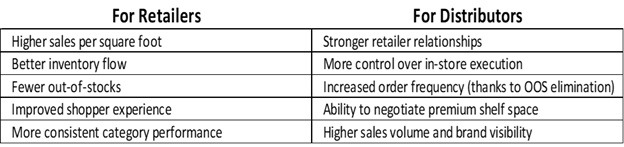
Benefits for Retailers and Distributors
Conclusion
Optimizing retail store space is a collaborative effort, and distributors are uniquely positioned to empower retailers with the tools and insights needed for shelf-space maximization. By focusing on data, planograms, inventory, and shopper strategies, distributors not only enhance efficiency but also drive mutual growth in the supply chain. As retail evolves with technology and changing consumer behaviors, these partnerships will become even more essential for staying ahead. Retailers looking to revamp their spaces should consider deeper collaborations with distributors to unlock the full potential of their shelves.
At LaceUp Solutions, we explore how technology transforms distribution, from warehouse management and route optimization to digital sales enablement. Subscribe to the LaceUp Blog for weekly insights on wholesale growth, innovation, and the future of logistics. For more information, please get in touch with us to learn about our solutions.
I hope this article on optimizing store space have been helpful. I will continue to post information related to management, distribution practices and trends, and the economy in general. Our channel has a lot of relevant information. Check out this video on “Sales Rep App”.
Sorry, the comment form is closed at this time.