

How a Successful WMS Implementation Looks Like:IMS to WMS Upgrade-Part 4
You have survived the ROI analysis and navigated the vendor selection gauntlet. The implementation team has left the building, the scanners are charged, and the “Go-Live” cake has been eaten.
But how do you know if you actually won? A Successful WMS implementation isn’t just about the software “working”; it’s about a fundamental shift in the atmosphere and output of your facility. In 2026, a high-performing warehouse feels less like a chaotic storage unit and more like a high-precision data center. In this article, I describe how a Successful WMS implementation looks like in practice.
A Warehouse That Runs on System-Driven Operations
In a successful WMS implementation environment, the system is not passive; it actively drives operations. Employees do not decide where to store products or how to pick orders based on experience or convenience. Instead, the WMS directs every movement. When goods are received, the system assigns optimal storage locations based on predefined rules. When orders are released, they generate picking tasks that minimize travel time and maximize efficiency.
This shift from human-driven to system-driven operations is one of the clearest indicators of success. It reduces variability, standardizes processes, and ensures that performance doesn’t depend on individual knowledge.
Real-Time Inventory Accuracy You Can Trust
One of the most immediate and measurable outcomes of a well-implemented WMS is inventory accuracy. In high-performing warehouses, inventory records match physical stock with a high degree of reliability (often above 98–99 percent accuracy). This is achieved through continuous tracking of all movements and the use of cycle counting instead of disruptive full physical inventories.
Managers no longer question whether inventory data is correct. Sales teams can confidently promise product availability. Purchasing decisions are based on accurate information rather than assumptions.
This level of visibility fundamentally changes how the business operates, reducing safety stock requirements while improving service levels.
Structured, Predictable Warehouse Processes in a Successful WMS
A successful WMS implementation replaces improvisation with structure. Receiving follows a defined process that includes verification, labeling, and directed put-away. Picking follows optimized routes and standardized methods, such as batch or wave picking. Replenishment occurs systematically, ensuring that forward pick locations are always stocked. Because processes are clearly defined and system-controlled, operations become predictable. Managers can anticipate workloads, balance labor, and plan daily activities with confidence. This predictability is particularly valuable during peak periods, when poorly structured operations tend to break down under pressure.
Measurable Productivity and Clear KPIs in a Succesful WMS Implementation
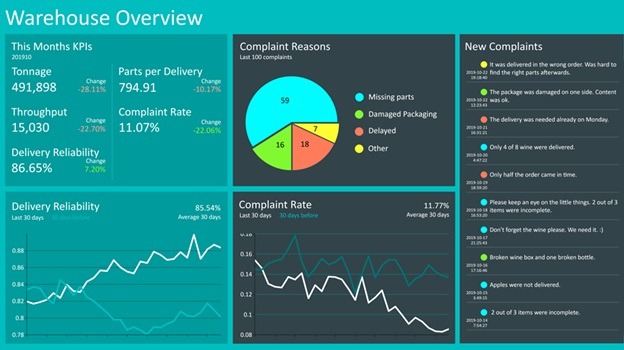
In a mature WMS environment, performance is no longer estimated; it is measured. The system captures detailed data on every activity, allowing companies to track key performance indicators such as:
- Picks per hour
- Order accuracy rates
- Dock-to-stock time
- Order cycle time
- Inventory turnover
This visibility enables continuous improvement. Managers can identify bottlenecks, compare performance across shifts, and implement targeted improvements. More importantly, performance discussions shift from opinions to data-driven decisions.
Seamless Integration Across the Business
A successful WMS does not operate in isolation. It becomes a central component of an integrated technology ecosystem. Orders flow into the warehouse from ERP and CRM systems, inventory updates synchronize with financial platforms, and shipment data feeds transportation, DSD, and Routing systems. This integration ensures that all departments, sales, operations, finance, and customer service, work with consistent, real-time information. The result is improved coordination across the organization and faster, more reliable decision-making.
A Workforce That Is Aligned with the System
Technology alone does not create success. A well-implemented WMS is supported by a workforce that understands and trusts the system. Employees are trained not only on how to use the system but also on why processes are structured the way they are. They follow system instructions consistently, knowing that this leads to better performance and fewer errors. Supervisors focus less on firefighting and more on managing performance and improving processes. When the workforce is aligned with the system, adoption becomes natural, and resistance to change is minimized.
Scalability Without Operational Chaos
Perhaps the most important sign of a successful WMS implementation is the ability to grow without losing control. As order volumes increase, new customers are added, or additional warehouse locations are opened, the operation continues to function efficiently. Processes remain consistent, inventory accuracy is maintained, and service levels do not deteriorate. Instead of reacting to growth with increased complexity and confusion, the organization absorbs it with structure and control. This scalability is what transforms a WMS from a tactical tool into a strategic asset.
The “After” Comparison
| Feature | The “IMS” Warehouse (Before) | The “WMS” Warehouse (After) |
| Inventory | “I think it’s in Aisle 3.” | “Bin A4-B2, Level 3.” |
| Staffing | Relies on 3 “experts.” | Anyone with a scanner is an expert. |
| Returns | 3% due to shipping errors. | <0.2% due to scanning validation. |
| Growth | Adding volume adds chaos. | Adding volume adds profit. |
Conclusion
A Warehouse Management System is not successful simply because it is live. It is successful when it changes how the warehouse operates. For companies that fully embrace the system, the benefits extend far beyond the warehouse. Inventory becomes more accurate, customer service improves, costs are reduced, and the business gains the operational foundation needed to scale. In the end, a successfully implemented WMS is not just a better system. It is a better way of running the entire operation.
At LaceUp Solutions, we explore how technology transforms distribution, from warehouse management and route optimization to digital sales enablement. Subscribe to the LaceUp Blog for weekly insights on wholesale growth, innovation, and the future of logistics. For more information, please get in touch with us to learn about our solutions.
I hope this article about a successful WM implementation have been helpful. I will continue to post information related to management, distribution practices and trends, and the economy in general. Our channel has a lot of relevant information. Check out this live demo of a WMS.
Sorry, the comment form is closed at this time.