

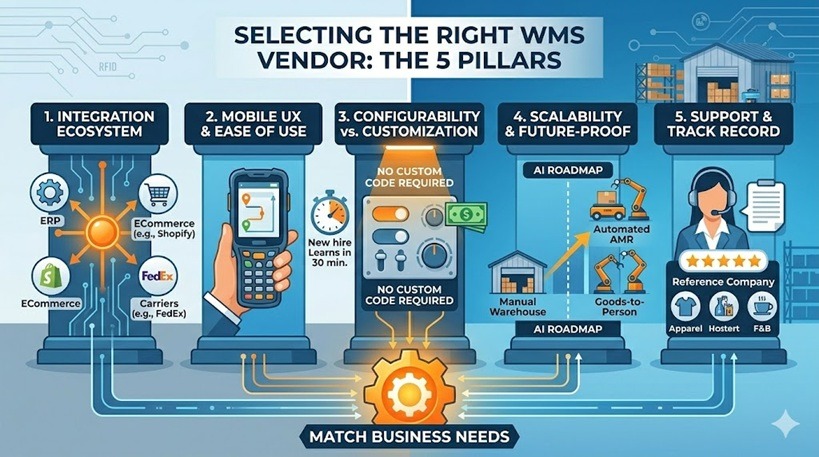
Part 3: How to Evaluate and Select the Right WMS Vendor to Replace your IMS
In the first article of this series, we identified the “when” of upgrading, and in the second, we proved the financial “why.” Now comes the most daunting step: The “Who.” A mismatched choice can lead to prolonged implementations, hidden costs, and underwhelming ROI; while the right partner accelerates efficiency, scalability, and future-proofing. In this third article in the series, I focus on a structured, step-by-step approach to evaluate a WMS vendor and making the best selection for your business.
Start by Understanding Your Operational Requirements
Before contacting vendors, companies must first analyze their own operations. This step is often overlooked, yet it is essential for selecting the right solution. Every warehouse has unique characteristics. Some handle high volumes of fast-moving consumer goods, while others manage complex manufacturing components or regulated products with strict traceability requirements. A WMS designed for e-commerce fulfillment may not be suitable for a distributor that manages Direct Store Delivery routes or lot-controlled inventory.
The evaluation process should begin with a clear definition of operational needs. This includes understanding the number of SKUs, the volume of daily transactions, storage strategies, and any regulatory requirements such as lot tracking or expiration management. Companies that take the time to map their warehouse processes (receiving, put-away, picking, packing, and shipping) are better equipped to identify the capabilities a WMS must provide.
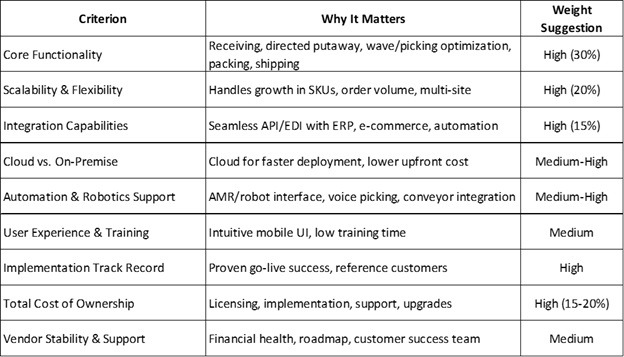
Key evaluation criteria for shortlisting a WMS Vendor
The WMS market is mature, with dozens of options ranging from enterprise giants to agile cloud specialists. The table reflect the key criteria to consider when selecting a WMS Vendor.
Consider Integration with Existing Systems
A warehouse management system rarely operates in isolation. It must integrate with other core business systems such as enterprise resource planning (ERP), customer relationship management (CRM), DSD and transportation systems, and accounting platforms. The WMS must exchange information seamlessly with these systems so that orders, inventory levels, and shipment data remain synchronized across the organization.
During the evaluation process, companies should carefully examine how integrations are implemented. The right WMS Vendor should be able to demonstrate proven integrations with common platforms and explain how data synchronization occurs in real time. Poor integration design can create operational bottlenecks and undermine the efficiency gains that the WMS is intended to deliver.
Assess the WMS Vendor Industry Experience
Not all WMS vendors specialize in the same types of operations. Some systems are optimized for retail distribution, others for manufacturing environments, and others for e-commerce fulfillment centers. Selecting a vendor with experience in your industry can significantly reduce implementation risks. A vendor familiar with your sector will already understand common operational challenges, compliance requirements, and integration needs. They can also provide practical guidance during implementation, helping you avoid common mistakes. Customer references are particularly valuable at this stage. Speaking directly with existing clients allows companies to learn how the system performs in real-world conditions.
Evaluate Implementation and Support Capabilities
Selecting the right technology is only part of the equation. The implementation process plays a major role in determining whether the project succeeds. WMS implementations require configuration, integration, data migration, and user training. Vendors should provide a structured implementation methodology and clearly define the roles and responsibilities of both the vendor and the customer.
Equally important is the quality of ongoing support. Warehouse operations run continuously, and system downtime can quickly disrupt fulfillment activities. Companies should evaluate the vendor’s support structure, including response times, escalation procedures, and availability of training resources.
Look Beyond the Current Needs of Your Warehouse
A warehouse management system is typically a long-term investment. Many organizations operate the same WMS for a decade or more. For this reason, companies should evaluate whether the system can support future operational growth. This includes the ability to handle larger transaction volumes, additional warehouse locations, and emerging technologies such as automation, robotics, and real-time analytics. Selecting a scalable system ensures that the technology will continue to support the business as it expands.
Develop a Structured WMS Vendor Selection Process
To make the best decision, companies should approach vendor selection systematically. This often involves issuing a Request for Proposal (RFP), comparing vendors based on defined evaluation criteria, and conducting live demonstrations of the software using realistic operational scenarios.
Structured evaluations help ensure that decisions are based on objective analysis rather than marketing presentations. They also allow organizations to compare a WMS vendor on critical dimensions such as functionality, implementation approach, total cost of ownership, and long-term strategic fit.
Conclusion
Evaluating and selecting a WMS vendor requires discipline, cross-functional alignment, and a focus on long-term fit rather than short-term hype. By following this structured approach, defining needs clearly, shortlisting objectively, testing rigorously, and calculating true TCO, you position your business for a successful transition that delivers the efficiency, accuracy, and scalability promised in our earlier articles.
At LaceUp Solutions, we explore how technology transforms distribution, from warehouse management and route optimization to digital sales enablement. Subscribe to the LaceUp Blog for weekly insights on wholesale growth, innovation, and the future of logistics. For more information, please get in touch with us to learn about our solutions.
I hope this article about the WMS ROI stemming from switching an Inventory Management System have been helpful. I will continue to post information related to management, distribution practices and trends, and the economy in general. Our channel has a lot of relevant information. Check out this video on what is a WMS.
Sorry, the comment form is closed at this time.