

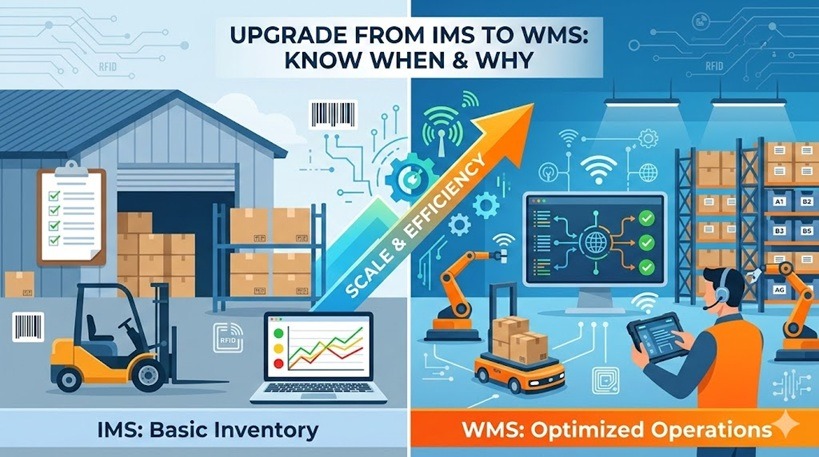
Why and When to Change Your Inventory Management System to a WMS
An Inventory Management System (IMS) serves as a foundational solution for monitoring inventory levels, orders, sales, and deliveries across the supply chain. However, as companies scale, the limitations of an IMS become apparent, prompting a shift to a more robust Warehouse Management System (WMS). A WMS goes beyond mere tracking, optimizing the intricate details of warehouse activities, including picking, packing, shipping, and real-time inventory movement. In this article, I explore the key reasons to upgrade and the optimal timing for making this transition, helping business owners decide if it’s time to level up their operations.
Understanding the Key Differences Between Inventory Management System and WMS
Before diving into the “why” and “when,” it’s essential to clarify what sets these systems apart. While both deal with inventory, their scopes and functionalities differ significantly:
Scope: An IMS provides a broad, high-level overview of inventory across the entire supply chain, focusing on quantities, locations, and basic tracking. In contrast, a WMS zooms in on warehouse-specific operations, managing the flow of goods within the facility with greater detail and precision.
Functionality: IMS handles tasks like order processing, stock level monitoring, and forecasting, but it often lacks the tools for optimizing physical movements. A WMS, however, includes advanced features such as directed picking, slotting optimization, labor management, and integration with automation technologies like RFID or conveyor systems.
Real-Time Capabilities: IMS typically offers periodic updates, which can lead to discrepancies in fast-moving environments. WMS provides real-time visibility, ensuring accurate data on stock locations and movements.
Integration: While IMS might integrate with ERP systems for financial tracking, WMS excels in syncing with transportation management systems (TMS) and e-commerce platforms for seamless end-to-end operations.
To visualize these distinctions, consider the following diagram:

Why Make the Switch from an Inventory Management System to a WMS?
The transition to a WMS isn’t just about having more buttons to click; it’s about solving specific operational headaches that an Inventory Management System isn’t designed to handle.
Granular Visibility: A WMS provides “bin-level” tracking. You won’t just know you have 50 units in the building; you’ll know 10 are on the receiving dock, 30 are in Aisle 4, and 10 are currently on a picker’s cart.
Labor Optimization: A WMS uses logic to direct workers. It can calculate the shortest path through the warehouse (pathing) or group similar orders together (batch picking) to minimize walking time.
Error Reduction: By implementing strict barcode scanning and validation at every step (pick, pack, ship), a WMS can improve your order accuracy to 99.9%.
Advanced Fulfillment: If you deal with complex requirements such as “First-In-First-Out” (FIFO), lot tracking for perishables, or kitting/assembly, a WMS is necessary.
When Is the Right Time to Make the Switch?
Timing the transition from an Inventory Management System is critical to avoid disruptions. Look for these signs that your IMS is no longer sufficient:
- Rapid Business Expansion: If your order volume has doubled or you are opening new facilities, it is time. Businesses that outgrow their IMS often experience fulfillment bottlenecks.
- Frequent Operational Inefficiencies: Are you dealing with stock discrepancies, delayed shipments, or high return rates due to errors? These are red flags indicating the need for WMS’s detailed control.
- Rising Labor Costs: If manual processes are inflating your payroll without corresponding output gains, WMS can automate tasks and optimize workforce allocation.
- E-Commerce or Multi-Channel Growth: With the rise of online sales, integrating with platforms like Amazon or Shopify requires WMS-level sophistication to handle omnichannel demands.
- Technology Upgrades: If you’re implementing ERP, automation, or IoT devices, a WMS integrates more seamlessly than an IMS, future-proofing your operations.
Potential Challenges and Considerations when switching an Inventory Management System to a WMS
While the benefits are clear, the switch isn’t without hurdles. Implementation can involve upfront costs, staff training, and data migration. To mitigate this, conduct a thorough needs assessment and WMS ROI, choose a scalable WMS provider, and phase the rollout. Many companies report ROI within 12-18 months through cost savings and efficiency gains.
Conclusion
Transitioning from an InventoryManagement System to a WMS is a strategic move for businesses aiming to thrive in competitive markets. If inefficiencies plague your operations or you are poised for growth, now might be the ideal time to upgrade. By enhancing visibility, accuracy, and scalability, a WMS not only resolves current issues but also positions your supply chain for future success. Evaluate your current setup against these criteria, and consult experts to ensure a smooth migration.
At LaceUp Solutions, we explore how technology transforms distribution, from warehouse management and route optimization to digital sales enablement. Subscribe to the LaceUp Blog for weekly insights on wholesale growth, innovation, and the future of logistics. For more information, please get in touch with us to learn about our solutions.
I hope this article about switching an Inventory Management System have been helpful. I will continue to post information related to management, distribution practices and trends, and the economy in general. Our channel has a lot of relevant information. Check out this video on what to do When Your Warehouse Is a DISASTER.
Sorry, the comment form is closed at this time.