


The Distribution “Glass Ceiling”: Why Distributors Stay Small
In the distribution industry, growth is often perceived as a natural progression: more customers, more products, more routes, more revenue. Yet, many distributors remain small for years, even decades, despite operating in growing markets. This isn’t always due to a lack of opportunity. More often, it is the result of structural, operational, and strategic limitations that quietly cap their potential. In this article, I describe the factors that keep small distributors stagnant. Understanding these constraints is the first step toward overcoming them.
1. Cash Flow and Capital Constraints: The Small Distribution Trap
Distribution is inherently a cash-intensive business. Small distributors must buy inventory upfront from suppliers, often on short credit terms, then sell to retailers or end customers who may pay 30–60 days (or longer) later. When customer payment cycles outpace supplier terms, the result is a negative cash flow cycle that starves the business of liquidity.
This creates a vicious loop: limited cash means thinner inventory, slower fulfillment, and missed opportunities to take on bigger accounts. Banks and lenders view small distributors as high-risk due to thin margins (often 5–15% in competitive categories) and volatile demand, making it hard to secure growth capital..
2. Small Distributors Leadership Mindset: Micromanagement, Comfort Zones, and Talent Issues
A common refrain in distribution circles: “The owner does everything.” Refusing to delegate keeps operations nimble at first, but it becomes a bottleneck as complexity grows. Poor employee retention follows, high turnover in warehouses and sales teams is rampant when processes are chaotic and pay is modest.
Many owners fall into a comfort zone after early success. They prioritize lifestyle over aggressive expansion, avoid risky investments in technology or new markets, and resist dropping unprofitable SKUs. Family-owned firms (which dominate the smaller end of the industry) often face additional succession or internal politics challenges.
3. Lack of Economies of Scale: Competing on Uneven Ground
Large distributors spread fixed costs (warehousing, transportation, administration) across massive volumes, negotiate deeper supplier discounts, and offer wider assortments with faster delivery. Small players pay more per unit, struggle with minimum order quantities from manufacturers, and can’t match pricing or service breadth.
Industry surveys peg the practical “ceiling” for many small distributors at around $10 million in annual sales, with $100 million marking the floor for large-scale operations. Below that threshold, the math simply doesn’t work for national contracts or heavy automation. Small distributors often serve fragmented markets of tiny customers, exactly the segment big players now serve efficiently via e-commerce and automated ordering. This leaves small firms squeezed between price pressure from above and razor-thin margins from below.
4. Lack of Integrated Technology
At a small scale, spreadsheets, email, and manual data entry feel manageable. But as volume grows, chaos ensues. Information silos emerge: sales tracks orders one way, purchasing another, and warehouse operations yet another. Inventory becomes a guessing game, leading to overstock (tying up cash) or stockouts (lost sales and unhappy customers). Manual processes multiply errors, delay invoicing, and force staff into administrative drudgery rather than value-adding work. There is often hesitation to invest in systems like WMS, DSD software, or ERP platforms due to:
- Upfront costs
- Implementation concerns
- Fear of disrupting current operations
While this caution is understandable, it creates a long-term disadvantage.
5. Weak Sales, Marketing, and Product Strategy
Many small distributors rely on founder relationships and word of mouth rather than structured sales processes or digital marketing. In a market where nearly 90% of B2B buyers research online first, an outdated website or absent e-commerce presence is fatal. Poor market understanding leads to carrying “bad products”; lines that don’t meet customer needs but linger due to emotional attachment or fear of losing any revenue.
Deficient planning exacerbates this. Without clear growth strategies, market analysis, or customer segmentation, efforts scatter. Owners chase every opportunity instead of doubling down on high-margin niches where personal service and expertise still win.
Summary Table: Small vs. Scalable Distribution
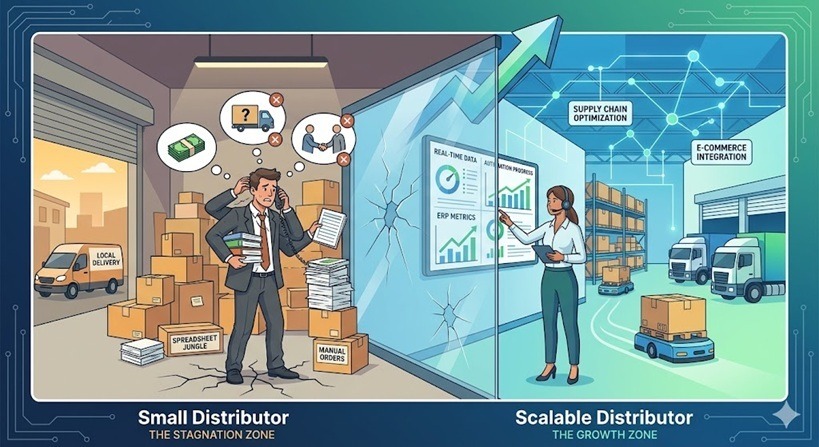
The following table and image compare the stagnant and scalable distributor factors.
| Feature | Small Distributor (Stagnant) | Scalable Distributor (Growing) |
| Capital | Limited | Large and access to credits |
| Decision Making | Centralized in the Owner | Delegated to specialized Managers |
| Sales Strategy | Personality-based / Reactive | Data-driven / Proactive |
| Technology | Manual Entry / Spreadsheets | Integrated ERP / E-commerce |
| Inventory | “Just in case” (Guessing) | “Just in time” (Data-driven) |
| Focus | Daily Firefighting | Long-term Strategy |
Conclusion
Staying small isn’t always a failure; for some, it’s a choice. But for those aiming for the next level, the shift requires moving from a product-focused mindset to a systems-focused mindset. The distributors that break through are those that stop viewing technology and management as “overhead” and start viewing them as the engine for the next $50 million in growth.
At LaceUp Solutions, we explore how technology transforms distribution, from warehouse management and route optimization to digital sales enablement. Subscribe to the LaceUp Blog for weekly insights on wholesale growth, innovation, and the future of logistics. For more information, please get in touch with us to learn about our solutions.
I hope this article have been helpful. I will continue to post information related to management, distribution practices and trends, and the economy in general. Our channel has a lot of relevant information. Check out this video on the subject.
Sorry, the comment form is closed at this time.