

IMS to a WMS Part 2: The Financial Case for Upgrading an IMS to a WMS (WMS ROI Implementation)
In our previous article, we explored the operational shift from an Inventory Management System (IMS), focused on what you have, to a Warehouse Management System (WMS), focused on how you move it.
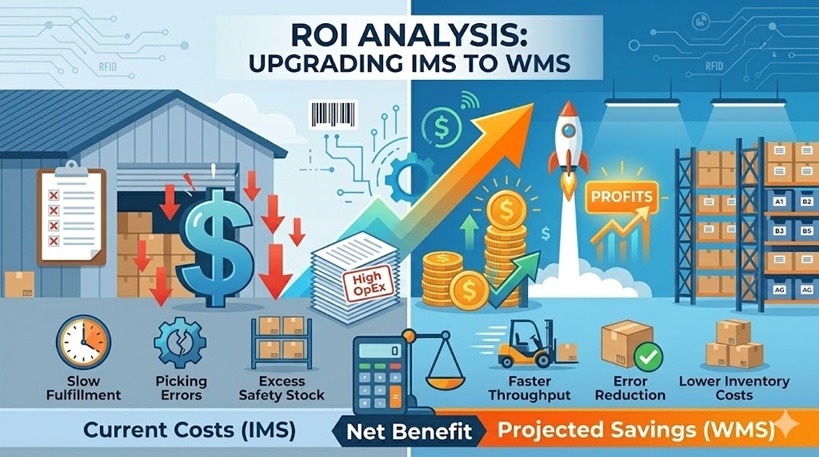
While the operational benefits of a WMS (like bin-level visibility and directed picking) are clear, the price tag can be daunting. A WMS is not just an expense; it’s a capital investment. And like any major investment, it requires a rigorous Return on Investment (ROI) analysis to justify the upfront costs against long-term gains. In this article, I explain how to build a WMS ROI case for upgrading from an IMS to a WMS.
The WMS ROI Formula
The basic ROI calculation is straightforward, but the devil is in the details of quantifying the benefits.

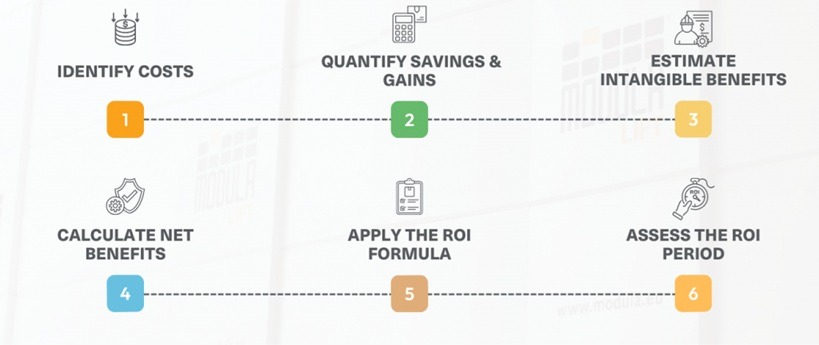
To get to this number, you must create a baseline of your current costs under the IMS and compare them against projected scenarios with a WMS over a 3-to-5-year period. This step-by-step infographic outlines the proven process for calculating automation ROI.
The Cost Side of a WMS ROI: What Are You Actually Paying?
A WMS implementation has many components. Do not forget to include:
- Software Licenses/Subscription: Upfront costs for on-premise or monthly fees for SaaS (Cloud).
- Implementation Services: Fees for the vendor or consultants to configure the system, map your warehouse layout, and integrate it with your ERP or commerce platforms.
- Hardware: This is often underestimated. You will need rugged mobile scanners, thermal label printers, perhaps tablets for supervisors, and a robust mesh Wi-Fi network throughout the facility.
- Training and Onboarding: The cost of taking your staff off the floor to learn the new system, plus the temporary productivity dip during the “go-live” phase.
The Benefit Side of a WMS ROI: Quantifying the Savings
This is where the WMS shines. You must turn operational improvements into dollars and cents.
A. Labor Efficiency (The Biggest Winner)
Order picking typically accounts for 55% of warehouse operating costs. An IMS relies on tribal knowledge; a WMS uses logic to direct workers.
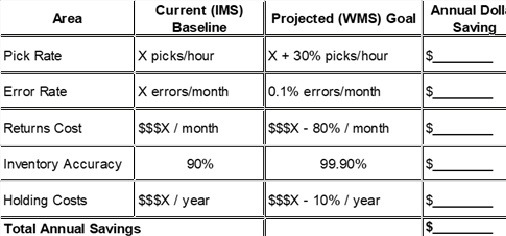
- How to quantify: Calculate your current average “picks per hour” per worker. A WMS typically improves this by 20–40% through optimized pathing, batch picking, and eliminating “searching” time.
- Example: If you have 10 pickers earning $40,000$ annually, and a WMS improves efficiency by 25%, you are effectively gaining $100,000$ in labor capacity without hiring.
B. Error Reduction (Mis-picks & Returns)
Returns are expensive. They involve reverse logistics, restocking labor, customer service time, and often, lost inventory value.
- How to quantify: Track your current “mis-pick” rate (e.g., 1%). WMS validation via barcode scanning can bring this down to 0.1%. Calculate the Cost Per Error (shipping both ways, labor, unsalable goods).
- Example: 1,000 errors/year at a conservative $50$ “cost to fix” each is $50,000$ in annual waste that a WMS can virtually eliminate.
C. Inventory Accuracy & Space Utilization
When you trust your numbers, you can hold less “safety stock.” A WMS enables dynamic slotting, utilizing vertical space more effectively.
- How to quantify: An IMS might have 90% accuracy; a WMS achieves 99.9%+. Improved accuracy can allow you to reduce inventory holding levels by 5–20%. Calculate your Inventory Carrying Cost (usually 20–30% of inventory value).
- Example: Reducing a $\$1M$ inventory by 10% frees up $100,000$ in working capital, saving roughly $\$25,000$ annually in carrying costs.
D. Increased Throughput (Revenue Growth)
If your IMS is the bottleneck preventing you from processing more orders during peak season, a WMS directly unlocks revenue growth. How to quantify: Estimate the number of additional orders you could ship during peak with existing staff. Multiply that by your average order value (AOV) and your margin.
3 Intangible (But Crucial) Benefits
Some benefits are hard to put in a spreadsheet but are vital for survival:
- Scalability: Can your IMS handle 10x the volume next year? A WMS is built for growth.
- Customer Satisfaction: Fewer errors and faster shipping mean better reviews and repeat customers.
- Compliance: If you sell food, pharmaceuticals, or electronic components, a WMS offers required lot tracking and serial number traceability.
Conclusion
If your IMS is causing stock discrepancies, delayed shipments, or forcing you to hire extra staff to keep up with growth, the financial case for a WMS is overwhelming. With typical payback periods of under two years and annual returns of 25–50% (or higher in strong cases), upgrading is one of the highest-ROI technology investments a distribution or e-commerce business can make.
At LaceUp Solutions, we explore how technology transforms distribution, from warehouse management and route optimization to digital sales enablement. Subscribe to the LaceUp Blog for weekly insights on wholesale growth, innovation, and the future of logistics. For more information, please get in touch with us to learn about our solutions.
I hope this article about the WMS ROI stemming from switching an Inventory Management System have been helpful. I will continue to post information related to management, distribution practices and trends, and the economy in general. Our channel has a lot of relevant information. Check out this video To Make Your Distribution Company More Profitable.
Sorry, the comment form is closed at this time.