

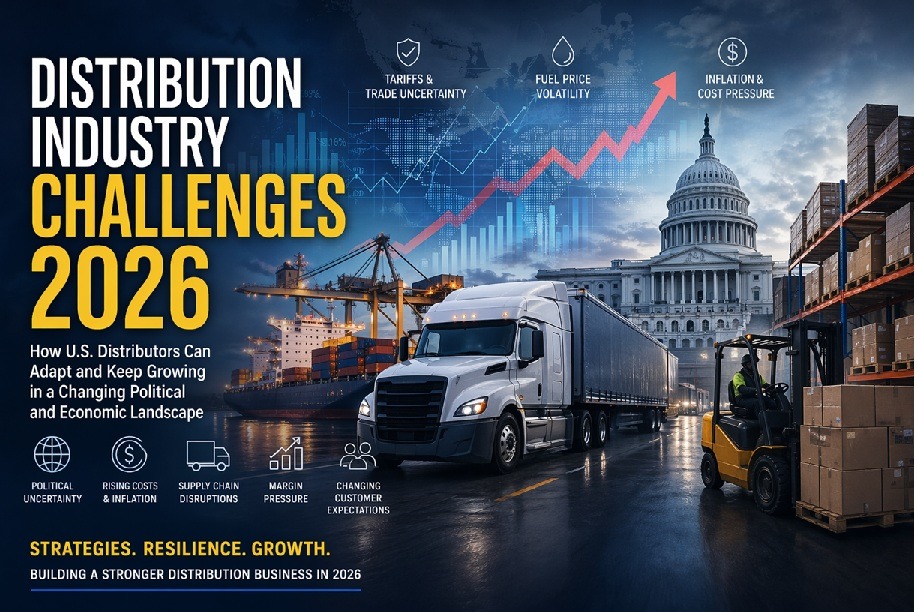
Distribution Industry Challenges 2026: How U.S. Distributors Can Adapt and Keep Growing
The distribution industry challenges 2026 represent a structural shift in how distribution businesses must operate. Political uncertainty, economic pressure, and global instability are no longer occasional disruptions; they are now constants that shape daily decision-making. For U.S. distributors, this environment is redefining margins, supply chains, customer expectations, and even the role of technology. Companies that continue to operate with pre-2020 strategies are finding it increasingly difficult to maintain profitability, while others are using this moment to modernize, differentiate, and grow. In this article, I explore the key political and economic forces impacting distributors, how these forces affect margins, operations, and growth, and practical strategies to adapt and continue expanding.
The Political and Economic Distribution Industry Challenges 2026 Reshaping Distribution
A World Where Geopolitics Directly Impacts Operations: One of the defining aspects of the distribution challenges 2026 is how closely global political events are tied to operational costs. Conflicts in key regions are no longer distant news; they directly influence fuel prices, freight availability, and delivery timelines across the United States. Energy markets have become highly sensitive to geopolitical tensions, and since transportation is a core component of distribution, fluctuations in fuel costs immediately translate into margin pressure.
At the same time, disruptions in global shipping routes and increased insurance costs for international freight are making imports more expensive and less predictable. For distributors dependent on international suppliers, this adds a layer of complexity that requires proactive planning rather than reactive adjustments.
Trade Policy and Tariffs: A Persistent Source of Uncertainty: Trade policy has become another central factor in the distribution industry challenges 2026. Tariffs, shifting trade agreements, and regulatory changes are creating an environment where product costs can change rapidly and without much warning.
Inflation Without Relief: One of the most challenging aspects in 2026, is that distributors often cannot fully pass these increases to their customers. Competitive pressure and price sensitivity limit the extent to which pricing can be adjusted, resulting in gradual but persistent margin compression. This creates a situation in which revenue may remain stable or even grow, while profitability declines. For many distributors, the impact of inflation is one of the most dangerous dynamics because it is not always immediately visible.
Demand Volatility and Changing Customer Behavior: Another key dimension of the distribution challenges In 2026 is the growing unpredictability of demand. Economic conditions are affecting customer segments differently, leading to fragmented consumption patterns. Some sectors continue to show strong demand, while others are cutting back significantly. This uneven behavior makes forecasting far more difficult and increases the risk of both overstocking and stockouts.
How These Challenges Are Transforming Distribution Operations
The combined effect of these forces is a fundamental shift in how distribution businesses operate.
Cost structures are no longer predictable, which makes traditional budgeting methods less effective. Inventory strategies are becoming more complex as companies try to balance availability with cash flow constraints. Operational processes are under strain due to the growing number of exceptions, adjustments, and disruptions that must be managed daily.
At the same time, the gap between operational complexity and customer expectations continues to widen. Distributors must operate more efficiently and accurately than ever, even as the environment becomes more difficult to control.
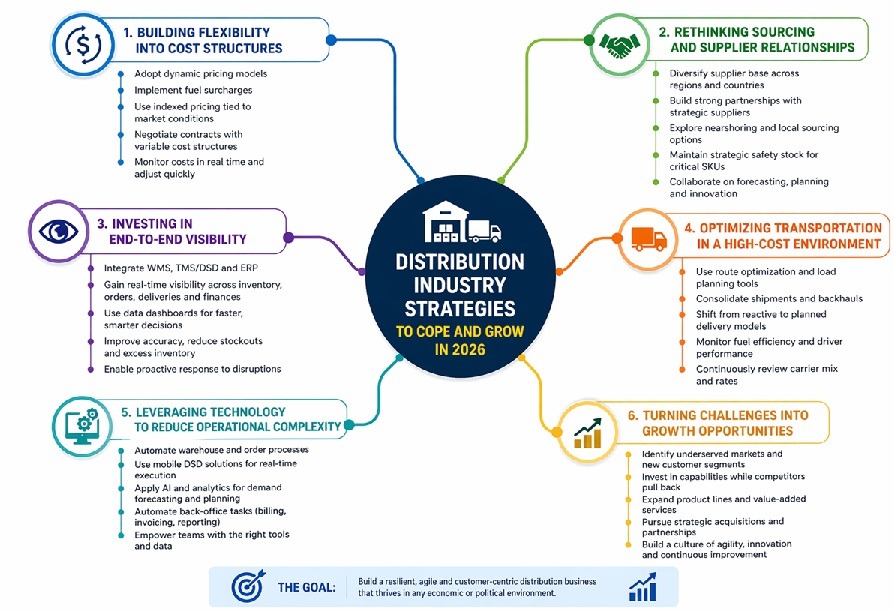
Strategies to Overcome Distribution Industry Challenges 2026
The map below explore the strategies that distributors might use to shield against the challenges of the 2026 external challenges.
Conclusion
Political instability, economic pressure, and operational complexity are no longer temporary obstacles; they are permanent features of the landscape. Distributors that recognize this shift and adapt accordingly will not only survive but grow. The key lies in building flexibility, investing in visibility, strengthening financial control, and leveraging technology to manage complexity.
At LaceUp Solutions, we explore how technology transforms distribution, from warehouse management and route optimization to digital sales enablement. Subscribe to the LaceUp Blog for weekly insights on wholesale growth, innovation, and the future of logistics. For more information, please get in touch with us to learn about our solutions.
I hope this article have been helpful. I will continue to post information related to management, distribution practices and trends, and the economy in general. Our channel has a lot of relevant information. Check out this video about inflation.
Sorry, the comment form is closed at this time.