

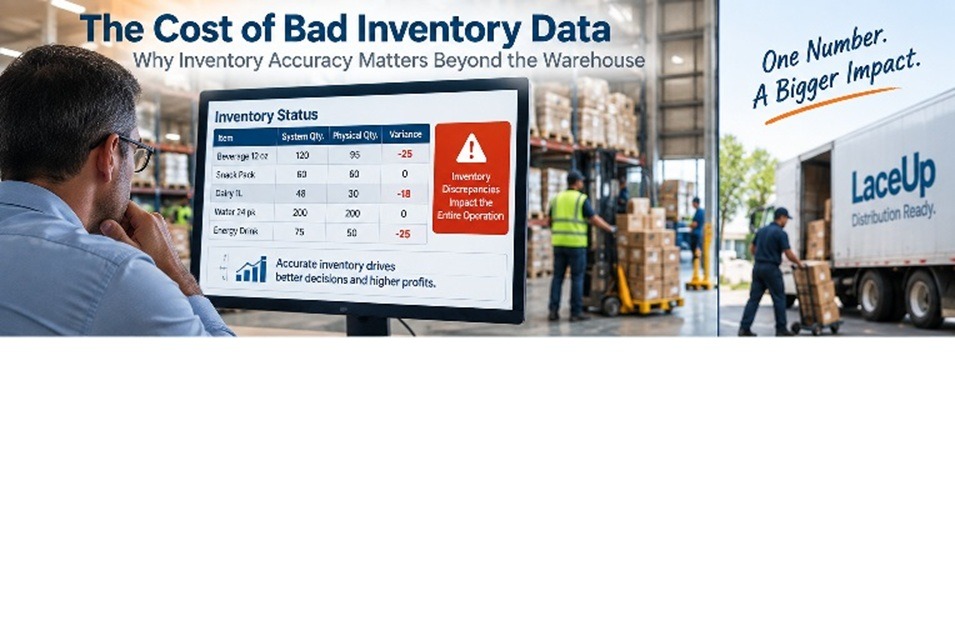
The Cost of Bad Inventory Data: Inventory Accuracy Matters Beyond the Warehouse
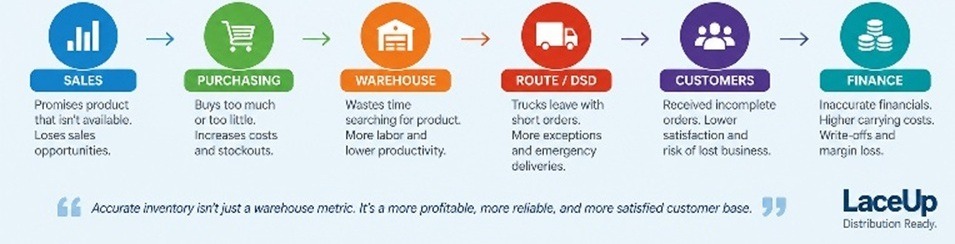
Most distributors treat Inventory Accuracy as a warehouse metric: something the warehouse manager tracks, reports on, and gets blamed for when a cycle count comes up short. That framing undersells the problem badly. A wrong number in the inventory system doesn’t stay contained to the warehouse. It travels: into the order a sales rep promises a customer, into the purchase order a buyer places to replenish stock, into the cost of goods sold figure the finance team reports to ownership. One inaccurate record, and every department downstream makes decisions on a number that was never true. In this article, I cover what this metric actually measures, where the cost of getting it wrong actually lands once you follow it past the warehouse door, and what it takes to fix the root cause rather than the symptom.
What Inventory Accuracy Actually Measures
This metric is fundamentally a data quality problem before it’s a warehouse problem. Data is considered high quality if it correctly represents the real-world construct it describes, and a dataset’s quality is measured against dimensions like accuracy, completeness, and timeliness. That same idea applies to a single number: does the quantity in the system match what is physically, actually on the shelf right now? Every other business function that touches that number is trusting it to be true. The industry baseline is not reassuring: retail operations average somewhere between 63% and 80% accuracy on this number, which means up to 37% of inventory records could be wrong at any given moment. Leading organizations target 98% to 99% accuracy or higher, and the gap between those two numbers is not a rounding error. It’s the difference between a business making decisions on real information and one making decisions on something closer to a guess with a decimal point.
The Problem Doesn’t Stop at the Warehouse Door
For DSD distributors, inventory accuracy becomes even more complicated because part of the company’s inventory is moving around on trucks. As we discussed in our previous article on Integrated WMS and Route Accounting, inventory does not disappear when it leaves the warehouse. It changes location.
Warehouse → Truck → Customer → Return → Warehouse
Every transfer, delivery, credit, damage, and return changes the inventory position. If warehouse and route systems are disconnected, the distributor may know what left the warehouse and what was invoiced to customers without having a reliable picture of what remains on each truck. This is where warehouse inventory accuracy becomes enterprise inventory accuracy. A case sitting on Truck 12 is still company inventory. The system should know where it is.
When Inventory is Wrong, Everybody Pays the Price
What Real Inventory Accuracy Requires
Fixing this at the root means treating it as a system property, not a warehouse discipline problem to be solved with more careful counting.
One inventory record shared by every department that touches it: Sales, purchasing, warehouse, and finance all need to be reading the same live number, not four separate exports that were accurate at four different points in time.
Transactions captured at the moment they happen, not batched for later entry: Every receipt, pick, return, and adjustment should update the system in real time. A delay between the physical event and the data entry is exactly where the numbers start to drift.
Lot and expiration tracking that doesn’t break when product moves: For food and beverage distributors, losing traceability the moment a case leaves a bin recreates the same accuracy gap the system was supposed to close.
Cycle counts that feed corrections back into the live system immediately: A count that surfaces a discrepancy but takes days to actually correct the record is just documenting the problem, not fixing it.
Visibility that lets every department see the same number, not just the warehouse team: If sales, purchasing, and finance are each looking at a different report, accuracy is a warehouse metric in name only: it hasn’t actually reached the people making decisions on it.
Conclusion
Inventory Accuracy is not a warehouse scorecard metric. It’s the shared foundation that sales, purchasing, and finance all build their decisions on, whether they realize it or not. A distributor that treats it as someone else’s problem to fix is really just choosing to let bad data keep traveling through the business unexamined: showing up as a broken customer promise here, an unnecessary purchase order there, and a finance team quietly reconciling numbers that never should have needed reconciling.
At LaceUp Solutions, our Warehouse Management System and DSD Route Accounting Software are built on one live inventory record that sales, purchasing, and finance all read from together, so the number everyone is deciding on is the same number, updated in real time. Subscribe to the LaceUp Blog for weekly insights, or contact us to see how LaceUp can help your operation get ahead of this year’s Q4 before it gets ahead of you.
I hope this article has been helpful. I will continue to post information related to management, distribution practices and trends, and the economy in general. Our channelhas a lot of relevant information. Check out this video on Cycle Count best Practices.
Sorry, the comment form is closed at this time.