

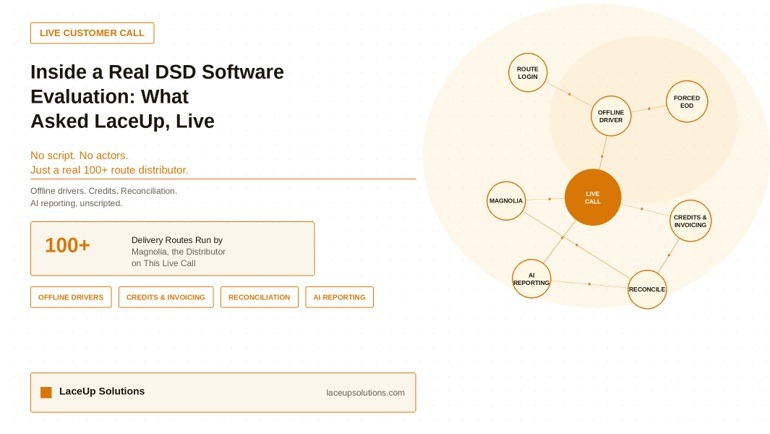
What a Customer Asked on a Live DSD Software Call With the LaceUp Team
Most software demos are rehearsed: a salesperson walks through a curated script, every click lands where it’s supposed to, and the questions from the “customer” are really just cues for the next slide. That is not what happened here. We just published a 35-minute recording of an actual video call between LaceUp/NCS and a customer (a distributor running more than 100 delivery routes) evaluating an upgrade to their route delivery system. No actors, no rehearsed questions, just the back-and-forth a real operations team has when they are deciding whether to move an entire route business onto a new system. In this article, I walk through what the customer actually asked about on this DSD Software call, why those specific questions matter, and what they reveal about how a distributor running 100-plus routes should be evaluating any DSD Software before committing to it.
WHY AN UNSCRIPTED DSD SOFTWARE CALL IS WORTH WATCHING
A case study is an in-depth, examination of a particular real-world instance, used to draw conclusions applicable beyond the specific case. That is exactly what this recording offers that a polished marketing demo cannot: instead of a vendor showing off the features they chose to highlight, it shows an actual buyer probing the features they actually cared about, in the order they actually cared about them. A live call with a real prospect tells you what an experienced distributor actually interrogates before trusting a system with their entire route.
WHAT A REAL DISTRIBUTOR ACTUALLY ASKED ABOUT IN THIS DSD SOFTWARE CALL
The call moves through more than twenty distinct topics, and the ones the customer’s team spent the most time on say a lot about where a growing distribution operation actually feels pain. Almost none of the questions on this DSD Software call were about whether the software could technically run a route. They were about what happens at the edges, when a driver goes offline, when a credit needs to be issued in the field, when the day has to close, and the numbers have to be right the first time. That is the real evaluation criteria for a distributor at this scale, and it is worth naming directly: control and accuracy under real-world conditions matter more than any single feature on a spec sheet. The figure lists the topics, which are summarized next.
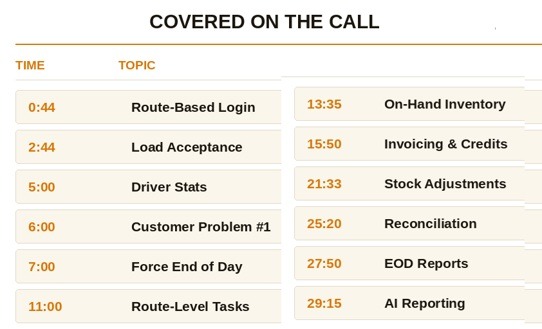
Drivers going offline mid-route and forced end-of-day closeouts. This was flagged as “Customer Problem #1” in the call for a reason: when a driver’s device loses connectivity or a route cannot be force-closed cleanly, the entire settlement and reconciliation process behind it stalls, a concern this blog has covered in depth in our piece on the hidden cost of manual driver settlement, and one the customer clearly wanted answered before going further.
Invoicing, credits, and reconciliation: A meaningful stretch of the call covers exactly how credits get applied, how invoices reconcile against what was actually delivered, and how stock adjustments and non-service stops get accounted for at day’s end. For a 100-plus route operation, this is not a minor workflow question; it is the difference between a close that takes minutes and one that takes hours every single day.
AI reporting built into the platform: Late in the call, the conversation turns to an AI reporting tool built directly into the platform rather than bolted on as a separate product. The customer’s interest here tracks with what this blog has argued elsewhere: distributors are no longer just asking whether a system can run routes, they are asking whether it can also help them understand the data those routes generate.
WHAT THIS LOOKS LIKE FOR YOUR OPERATION
If your distribution business is evaluating DSD software or re-evaluating a system you have outgrown, this call shows a reasonable template for what to ask before signing anything.
Ask about failure states, not just happy paths: Any vendor can show a route closing cleanly. Ask what happens when a driver’s device goes offline, when a delivery gets force-closed, or when a store rejects part of a load.
Push on reconciliation speed, specifically: Ask how long it takes to close a day across your actual route count, not a demo account with three stops.
Get specific about credits and invoicing: Field-issued credits, price discrepancies, and non-service stops are where most reconciliation headaches originate. Ask to see the exact workflow, not just hear it described.
Ask what reporting comes built in versus bolted on: A reporting layer that lives inside the same system as your operational data will always be faster to trust than a separate export-and-analyze process.
Watch how the vendor handles being asked something they did not expect: The call is valuable precisely because it was not scripted. If you can, push your own evaluation calls off-script the same way.
CONCLUSION
Most distributors researching DSD software read feature lists and watch curated demo videos. Very few get to see what an actual evaluation conversation sounds like between a serious buyer and a vendor being asked hard, unscripted questions. This Customer’s DSD software call is that rare look, and the topics they pushed on (offline drivers, clean reconciliation, credits, and built-in reporting) are a strong starting checklist for any distributor running enough routes that a bad system upgrade is not a minor inconvenience but a real operational risk.
At LaceUp Solutions, our DSD Route Accounting Software is built around exactly the scenarios This Customer’s team pressure-tested on this call: offline-resilient driver devices, clean forced end-of-day closeouts, field credit processing, and AI reporting built into the same platform that runs your routes. Subscribe to the LaceUp Blog for weekly insights, or contact us to see how LaceUp can help your operation run on the drivers you already have.
I hope this article on a live DSD software call have been helpful. I will continue to post information related to management, distribution practices and trends, and the economy in general. Our channel has a lot of relevant information. Check out this video on This Live customer call.
Sorry, the comment form is closed at this time.