

Lot Tracking and Traceability: Recalls, Expiration, and FSMA Compliance for Food Distributors
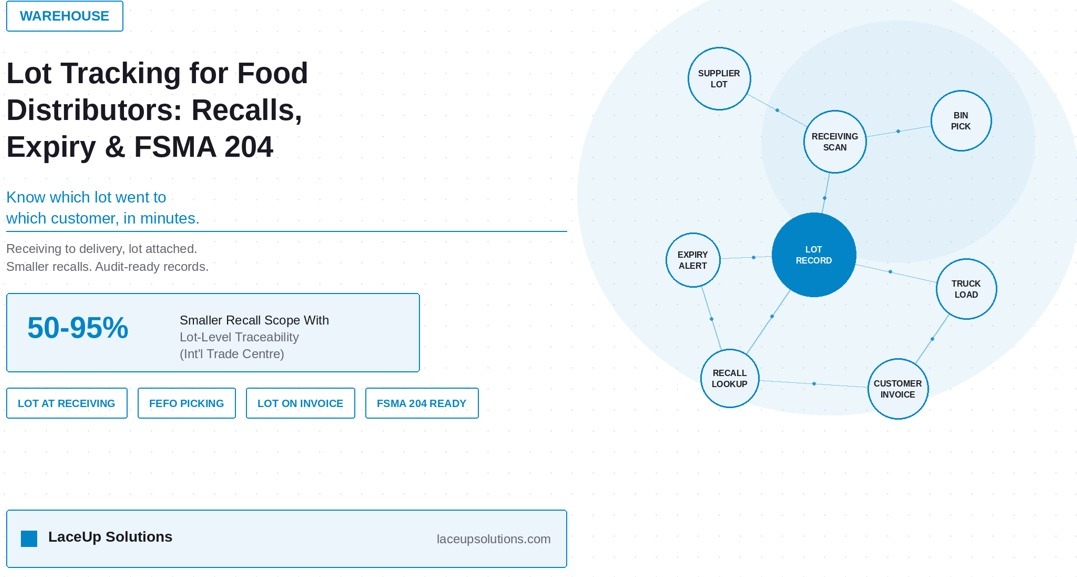
When a supplier issues a recall, a food distributor has one question to answer fast: which cases, shipped to which customers, on which dates, came from the affected lot? Distributors with a clean answer pull a few pallets and send a short list of stores to call. Distributors without one end up pulling everything, notifying every account that might have received the product, and absorbing the cost of guessing. The difference between those two outcomes is not luck. It is whether the warehouse and the route system were doing lot tracking all along. In this article, I cover what lot trackingtraceability is worth to a food distributor, what the FDA’s Food Traceability Rule actually requires and by when, and what a system needs to do so that the lot number stays attached to the product from the receiving dock to the customer’s back door.
FSMA Rule 204: From Basic Lot Tracking to Event-Driven Compliance
The FDA’s Food Safety Modernization Act (FSMA) Rule 204 (Food Traceability Final Rule) fundamentally changed record keeping requirements for businesses that manufacture, process, pack, or hold foods on the Food Traceability List (FTL). This list covers high-risk categories such as fresh-cut produce, soft cheeses, deli salads, nut butters, and fin fish. Under Rule 204, distributors can no longer rely on traditional “one-step-forward, one-step-back” paper invoices. Instead, they must maintain structured digital records tied to specific events:
Critical Tracking Events (CTEs):These are key supply-chain inflection points where products enter, move through, or exit a facility:
- Receiving: Taking custody of FTL foods from a supplier or carrier.
- Transformation: Processing, re-packing, or commingling products from multiple lots (if applicable).
- Shipping: Transporting food from one facility to a customer, retail store, or subsequent distributor.
Key Data Elements (KDEs):For every CTE, distributors must capture and retain specific metadata:
- Traceability Lot Code (TLC): The unique alphanumeric identifier tied to the production lot.
- TLC Source & Description: The facility where the TLC was originally assigned.
- Transaction Timestamps: Date and exact time of receipt or dispatch.
- Location Identifiers: Valid Global Location Numbers (GLNs) or facility addresses for origin and destination.
The 24-Hour Mandate: During an active FDA investigation, distributors must produce an electronic, sortable spreadsheet containing all relevant KDEs within 24 hours of the request. Manual filing systems cannot meet this standard.
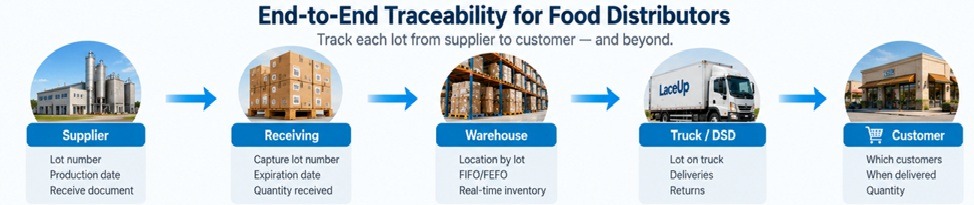
Traceability Has to Follow the Product
Effective Lot Tracking for Food Distributors begins at receiving. When inventory enters the warehouse, the distributor should capture the relevant lot and expiration information and link it to the received product. From that point forward, the information should travel with the inventory:
WHAT TO LOOK FOR IN A LOT TRACKING SYSTEM
Not every system that says it supports lots keeps them attached from end to end. These are the capabilities that matter.
- Capture lot and expiration at receiving: Scanning the lot at the dock against the purchase order is where the chain starts. Anything entered later is a reconstruction.
- Lot confirmation at the bin when picking: A picker scans the bin and product to confirm the lot being pulled. This is also what enforces first-expired, first-out or FEFO instead of FIFO, or leaving it to habit.
- Lot carried onto the truck and the invoice: The route system should record which lot went to which customer, so the invoice itself becomes the traceability record.
- Returns classified and re-lotted correctly: Product that comes back on the truck needs to go to damage, to redelivery, or back to its bin with its lot intact, not into a pile that loses its history.
- Fast lookup by lot, customer, and date: When a recall notice arrives, the system should answer within minutes which customers received that lot. If it takes a day, the system is storing lots without actually tracing them.
Operational Best Practices on the Floor and in the Field
Digitizing traceability requires strict validation at physical handoff points:
- Standardize on GS1-128 and 2D DataMatrix Scanning: Require inbound suppliers to label cases and pallets with standard GS1-128 or 2D barcodes containing Application Identifiers (AIs) for the GTIN, Lot Number (AI 10), and Expiration Date (AI 17). A single scan captures all required data without manual typing.
- Enforce Load-Out Validation: When staging and loading delivery trucks, require drivers or dockworkers to scan outbound pallets or master cartons. If a driver scans an unassigned lot, the mobile unit sounds an error alert and prevents dispatch until the error is resolved.
- Capture Lot Confirmation at Delivery (e-POD / DEX): Close the traceability chain at the customer’s receiving dock. Capturing lot data on the electronic Proof of Delivery (e-POD) or transmitting it through Direct Store Exchange (DEX) ensures an indisputable digital record of custody.
CONCLUSION
Lot-level traceability is not a technology preference for a food distributor. It is what limits a recall to one batch instead of a month of shipments, and it is what the FDA will expect to see by July 2028. The distributors who are ready are not the ones who write the best procedures. They are the ones whose lot numbers travel automatically with the product, from the receiving dock to the customer’s invoice, with no one retyping them along the way.
At LaceUp Solutions, our Warehouse Management System and DSD Route Accounting Software capture lot numbers and expiration dates at receiving, confirm them at picking, and carry them onto the truck and the invoice, so the lot tracking record builds itself as work gets done. Subscribe to the LaceUp Blog for weekly insights, or contact us to see how LaceUp can help your operation get ahead of this year’s Q4 before it gets ahead of you.
I hope this article about lot tracking has been helpful. I will continue to post information related to management, distribution practices and trends, and the economy in general. Our channel has a lot of relevant information. Check out this video on “Tracking beyond Expiration Date.”
Sorry, the comment form is closed at this time.