

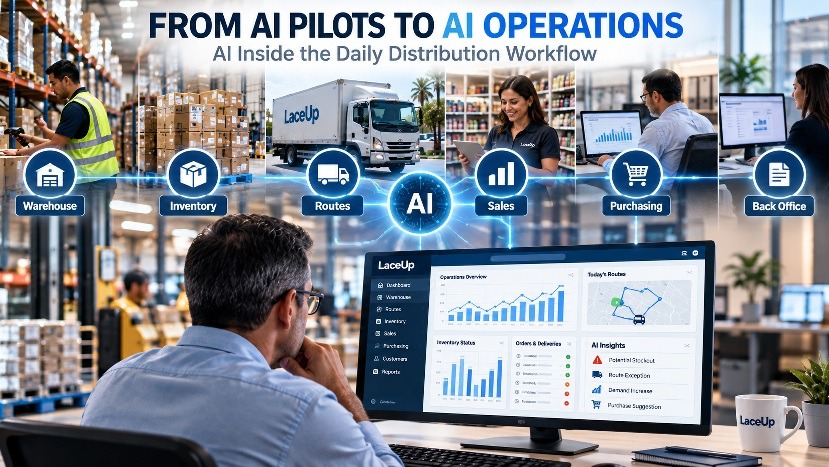
From AI Pilots to AI Operations: Why Distributors Need AI Into Their Daily Workflows
Artificial intelligence is no longer a futuristic concept for distribution. Most companies have already experimented with AI in some form, from generating emails and analyzing spreadsheets to forecasting demand or automating repetitive administrative tasks. Recent research from Distribution Strategy Group found that 93% of distributors consider AI a strategic priority, yet only 16% have deployed it across multiple business functions. The research, based on 233 wholesale distribution executives, exposes a significant gap between interest in AI and actually putting it to work across the organization. The next competitive advantage will not come simply from using AI: it will come from embedding AI Operations into the flow, so that intelligence becomes part of the workflows employees already use to buy, receive, store, sell, deliver, and account for products.
In this article, I cover why so many AI pilots never make it past the demo stage, what makes distribution especially hard to move past that stage, and what it actually takes to embed AI into daily workflows rather than parking it in a pilot that never scales.
Most Distributors Are Still in Pilot Mode
An employee using AI to write an email is useful. A manager uploading a spreadsheet and asking AI to analyze sales is also useful. But neither changes how the distribution operation works. These are individual productivity improvements. The real transformation begins when AI connects to operational data and becomes part of a business process. Consider the difference:
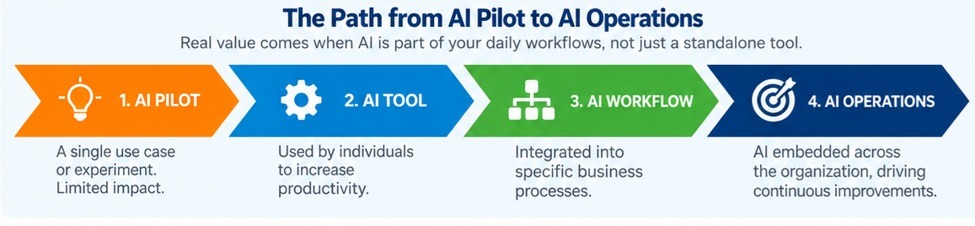
Pilot AI vs. AI Operations: Key Differences
An AI pilot tests whether the technology can solve a problem. An AI tool helps an individual perform a task faster. An AI workflow connects that intelligence to a specific business process. An AI-powered operation goes further. AI continuously analyzes what is happening across the organization, identifies situations requiring attention, recommends actions, and in some cases automatically executes routine tasks. That is where AI begins producing operational leverage.
| Dimension | Pilot / Sandbox AI | Operational AI (Embedded) |
| Data Cadence | Batch analysis, static weekly/monthly data dumps. | Continuous, real-time streams (telematics, scan data, live orders). |
| User Interface | Independent BI dashboards, external spreadsheets. | Native to the dispatcher’s dispatch board, the driver’s handheld app, or the picker’s RF gun. |
| Output Type | Observational metrics (e.g., “Customer X has a 34% churn risk”). | Prescriptive operational execution (e.g., “Auto-adjusted order frequency; safety stock trigger raised by 4 cases”). |
| Accountability | Owned by innovation teams or third-party consultants. | Owned directly by warehouse managers, logistics supervisors, and dispatchers. |
| Value Realization | Theoretical ROI modeled in presentations. | Tangible cost reductions: lower fuel burn, reduced overtime, fewer out-of-stocks. |
Workflows Where AI Operations Must Be Embedded, Not Consulted
From Warehouse and inventory, to sales and Backoffice, AI can help to optimize issues, recommend actions and automate routing work. Consider these workflows where AI Operations could be embedded with benefits.
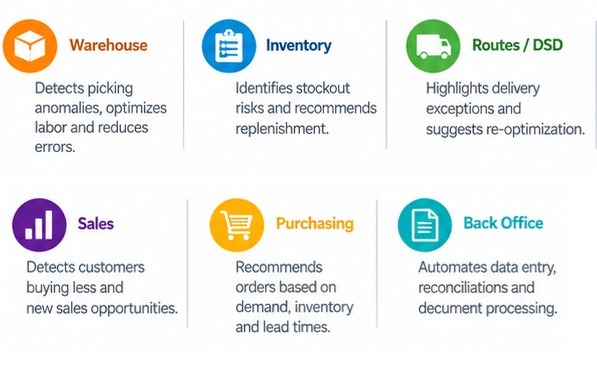
The Operational Blueprint: Moving from PoC to Production
Transitioning to an AI-driven operational standard requires a focused shift in software architecture and operational discipline:
- Build on High-Integrity APIs: AI engines cannot make accurate operational calls on stale data. Prioritize systems built on bi-directional, event-driven REST APIs that eliminate overnight batch synchronization.
- Design for Exception Handling, Not Full Replacement: Frontline teams distrust systems that act as opaque “black boxes.” Design embedded AI to automate the predictable 80% of routine tasks while surfacing complex anomalies (e.g., severe road closures, sudden out-of-stocks) directly to experienced operators with clear context.
- Measure Micro-Outcomes Over Macro-KPIs: Rather than tracking ambiguous metrics like “Overall Supply Chain Efficiency,” evaluate direct operational steps: Did dock door dwell time drop by 8 minutes? Did pickers increase units-per-hour by 12% without error spikes? Did order-entry cycle times decrease?
CONCLUSION
An AI pilot that never becomes part of daily operations is not really a failure of the technology; it’s usually a failure to plan for the much harder, much less glamorous work of embedding that technology into how the business actually runs. The distributors pulling ahead right now are not the ones who ran the most AI experiments. They’re the ones who took one real workflow, fixed the data underneath it, and built that capability directly into AI Operations.
At LaceUp Solutions, our Warehouse Management System, Route Accounting Software, and DSD platform embed AI directly into the daily workflow, not bolted on as a separate pilot tool, so the capability shows up where your team already works instead of sitting in a dashboard nobody opens. Subscribe to the LaceUp Blog for weekly insights, or contact us to see how LaceUp can help your operation get ahead of this year’s Q4 before it gets ahead of you.
I hope this article on AI Operations has been helpful. I will continue to post information related to management, distribution practices and trends, and the economy in general. Our channelhas a lot of relevant information. Check out this video on “How AI Will REALISTICALLY Help Your Company.”
Sorry, the comment form is closed at this time.