

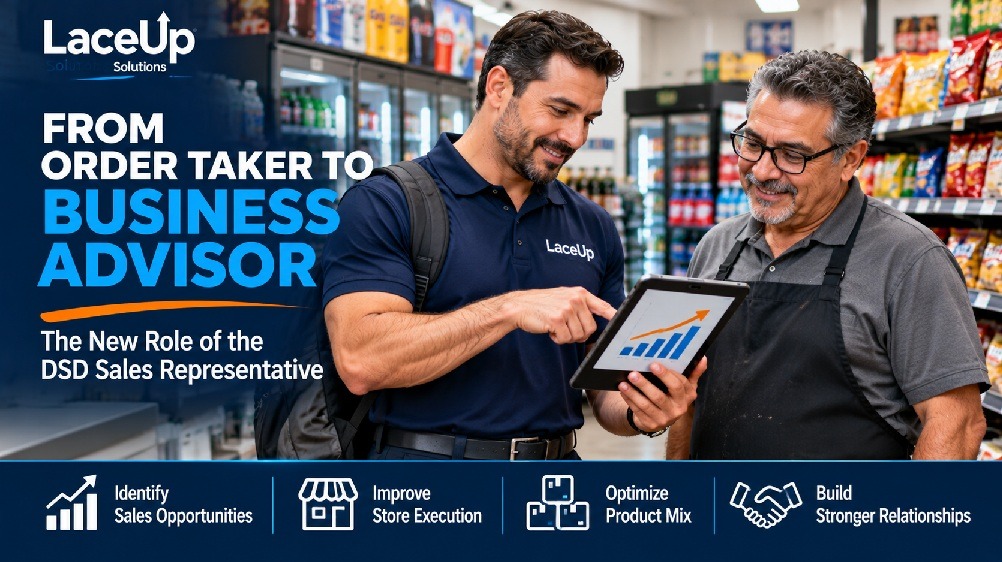
From Order Taker to Business Advisor: New Role of DSD Sales Representative
For decades, the primary responsibility of a DSD sales representative was straightforward: visit customers, check inventory, take orders, and make sure products were delivered. But retail customers need more than someone collecting orders. They need help keeping shelves stocked, selecting the right products, executing promotions, and increasing sales. This is changing the role of the DSD Sales Representative from an order taker into a business advisor who helps retailers grow. In this article, I look at how the role of the Direct Store Delivery sales representative is changing, why the reps who thrive are the ones who act less like order takers and more like partners in the customer’s business, and what a distributor needs to put in place to support that shift.
Why DSD Sales Representative Taking Orders Is No Longer Enough
Order takers are salespeople whose work consists mostly of determining what the customer needs, pointing to inventory that meets it, and completing the order. Relationship selling, also called consultative selling, is a practice built around long-term interactions in which the representative acts as a partner in the customer’s problem-solving. Those two descriptions are really two different jobs. The pressure to move from the first to the second comes from several directions at once. Forrester Research, summarized in trade publications, found that nearly 75% of B2B buyers say buying online is more convenient than buying from a sales rep, and concluded that order takers who add little value are the easiest to replace. That is general B2B research rather than DSD data, but the direction applies. When a customer can place a standard reorder without a visit, the visit has to be worth something more.
Technology Gives DSD Sales Representative More Time to Sell
Traditional sale visits often include repetitive administrative tasks: writing orders, checking prices, verifying availability, processing returns, and communicating with the warehouse. Mobile DSD sales applications can simplify much of this work. With access to updated product catalogs, customer-specific pricing, purchase history, promotions, and available inventory, representatives can spend less time managing paperwork and more time serving customers. Digital ordering also creates opportunities to reorganize sales activities.
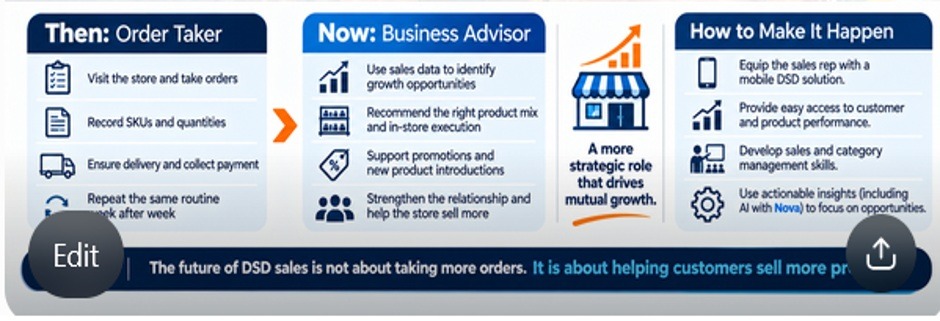
When customers can place routine replenishment orders through B2B self-service applications, representatives can concentrate on higher-value activities such as introducing products, improving displays, and developing customer relationships. Technology does not eliminate the need for salespeople; it lets them use their time more productively.
The New Sales Visit: Four Opportunities to Create Value
A modern DSD sales visit should focus on more than order volume.
Improve product availability. Identify missing products, recurring stockouts, and opportunities to improve replenishment.
Expand the assortment. Recommend relevant SKUs that the customer is not currently purchasing.
Execute promotions. Verify that promotional products, pricing, and displays are correctly implemented.
Strengthen customer relationships. Discuss sales opportunities, understand customer concerns, and recommend practical improvements.
These activities help transform the salesperson from a transaction processor into a trusted commercial partner.
Measuring the Value of the Modern Sales Representative
Traditional sales KPIs emphasize revenue, orders, and the number of customer visits. Those indicators remain important, but they tell only part of the story. Distributors should also consider metrics such as SKUs per Customer, New Product Penetration, Sales Growth per Account, Promotion Execution, and Customer Retention.
Together, these measures provide a better picture of how representatives contribute to customer development rather than simply processing orders. A salesperson who helps existing customers increase their purchases profitably can be just as valuable as one who continually opens new accounts.
Conclusion
The future of DSD sales is not about taking more orders. It is about helping customers sell more products. Distributors that move in that direction don’t need to replace their reps. They need to free them from paperwork, give them the information they need, and measure them by their customers’ success. The order still gets written, but it becomes the result of a good conversation instead of the whole point of the visit.
At LaceUp Solutions, our Sales Rep App and B2B Self-Service App give reps fast ordering, account history, and the tools to spend their time helping customers grow, while routine reorders flow in on their own. Subscribe to the LaceUp Blog for weekly insights, or contact us to see how LaceUp can help your sales team turn every stop into a growth conversation..
I hope this article on DSD Sales Representative role has been helpful. I will continue to post information related to management, distribution practices and trends, and the economy in general. Our channel has a lot of relevant information. Check out this video on What Is Pre-Sales Distribution & How It Works.
Sorry, the comment form is closed at this time.