

DSD PreSales vs Van Sales: Which Model Works Best for Your Distribution Business?
Two reps leave the warehouse at 7:00 a.m. One drives a truck loaded with product, sells to each store from the back of the truck, prints an invoice, and collects payment before pulling away. The other carries only a tablet. He takes an order at each stop, and a different truck delivers it the next morning. Both are doing direct store delivery, and both can be profitable. But they are very different businesses to run, and picking the wrong model for your products and customers quietly costs margin on every route. In this article, I compare Van sales vs Pre-sales side by side: how each one works, where each one wins, and how to decide which fits your distribution business, or whether a mix of both is the better answer.
Defining the Workflows: How Each Model Operates
The key distinction is when the sales transaction occurs relative to physical product picking and transport.
Pre-Sales: The Planned Replenishment Model
In Pre-Sales, a dedicated field sales representative visits the account or collects orders via EDI/B2B portal. The order is transmitted back to the distribution center, picked and packed during the night shift, and loaded onto a delivery truck for next-day or scheduled delivery. The driver is strictly focused on transit, offloading, and capturing the delivery confirmation.
Van Sales: The Mobile Cash-and-Carry Model
In Van Sales (also known as peddle sales or direct store sales), the truck acts as a rolling warehouse. The driver-salesperson arrives at the retail store without a confirmed purchase order, audits the shelf or cooler, sells the required quantity directly from truck inventory, prints an invoice on-site, and collects payment or signature in a single touchpoint.
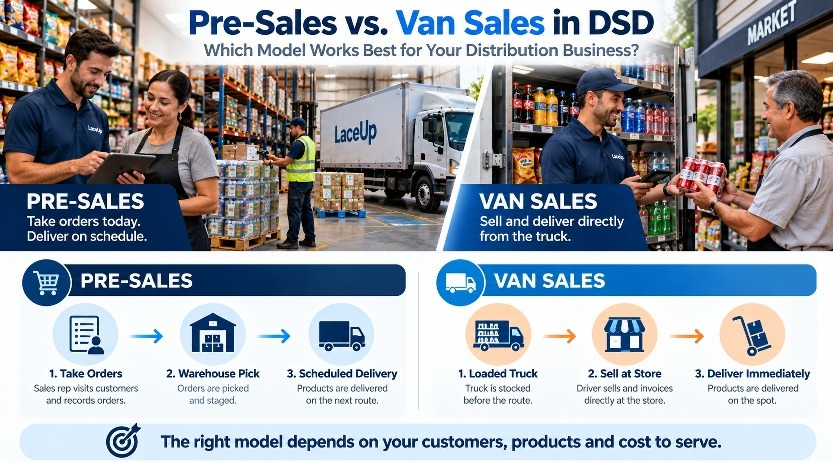
The figure illustrates how each model works and handles the same stop:
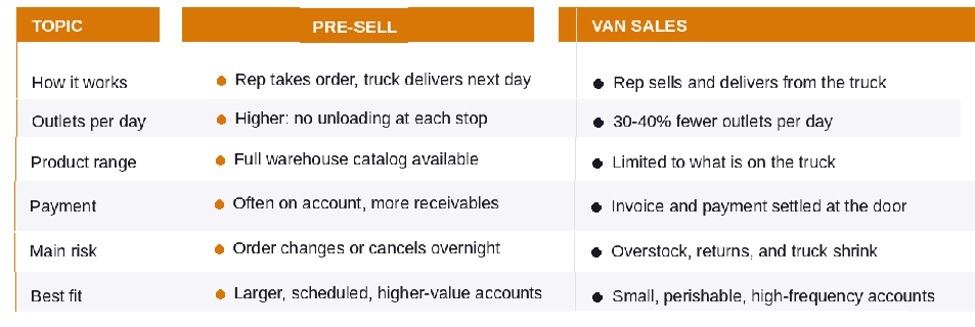
Van Sales vs Pre-sales Features
| Feature | Pre-Sales Model | Van Sales Model |
| Primary Customer Fit | Large supermarkets, big-box chains, key accounts. | Traditional trade, bodegas, mom-and-pop stores, kiosks. |
| Vehicle Payload Utilization | 100% Deterministic: Trucks carry only sold product. | Speculative: Trucks carry estimated rolling stock. |
| Inventory Shrink & Spoilage | Low; stock remains under warehouse WMS control until dispatch. | Higher risk of damage, theft, and expiration on the road. |
| Labor Profile | Specialized roles: Sales reps sell; non-sales drivers deliver. | High-touch: Driver must be a skilled salesperson and handler. |
| Order Flexibility | Low same-day flexibility; changes require order edits. | Immediate on-site upselling and promotional additions. |
| Capital Expenditure | Lower vehicle count needed; higher sales headcount. | Larger fleet footprint; specialized mobile printers & POS handhelds. |
Choosing the Right DSD Model
Deciding between Pre-Sales and Van Sales should start with a few practical questions. How frequently do customers order? How predictable is their demand? How many SKUs must be available? What is the average delivery size? How much does each customer visit cost? For many distributors, the best answer is not choosing one model over the other. It is using the right model for each customer segment while keeping operations connected. The objective is not simply to sell and deliver more. It is to serve every customer profitably.
Why Many Distributors Need Both Models
Consider a beverage distributor serving supermarkets, convenience stores, and independent retailers. Large supermarkets may prefer scheduled orders with predetermined quantities and delivery windows.
Convenience stores may need frequent replenishment and the flexibility to purchase additional products during a visit. Using the same selling model for both customer segments may create unnecessary costs or limit sales opportunities. A hybrid approach allows distributors to use Pre-Sales where demand is predictable and Van Sales where immediate selling creates value. The key is maintaining consistent customer, pricing, inventory, and financial information across both operations.
Technology Makes the Difference
Regardless of the model, distributors need reliable connections between sales, warehouse operations, truck inventory, delivery, and accounting. Modern DSD and Route Accounting software can support mobile order entry, customer-specific pricing, promotions, truck inventory control, electronic invoicing, returns, and driver settlement. For Pre-Sales, integration ensures that orders captured in the field reach the warehouse and delivery teams accurately. For Van Sales, it helps maintain visibility into what was loaded, sold, returned, and collected during each route. When both models operate within an integrated distribution environment, management gains a clearer picture of route performance and profitability.
CONCLUSION
No model is universally better; only one fits a given product, customer, and route. Van sales wins on immediacy, cash collection, and low administrative overhead for small, perishable, high-frequency accounts. Pre-Sale wins on coverage, range, and planning for larger or scheduled accounts. The fastest-growing distributors tend to measure both, assign each account to the model that best serves it, and run both from a single system.
At Laceup Solutions our DSD Route Accounting Software handles invoicing, payments, and inventory from the truck, while our Sales Rep App lets pre-sell reps take orders in the field, all on the same live inventory and customer data. Subscribe to the LaceUp Blog for weekly insights, or contact us to see Subscribe to the LaceUp Blog for weekly insights, or contact us to see how LaceUp can help your operation get ahead of this year’s Q4 before it gets ahead of you.
I hope this article about lot tracking has been helpful. I will continue to post information related to management, distribution practices and trends, and the economy in general. Our channel has a lot of relevant information. Check out this video on “DSD or PreSales”.
Sorry, the comment form is closed at this time.