

DSD Delivery Exceptions: How Small Errors Create Big Hidden Costs
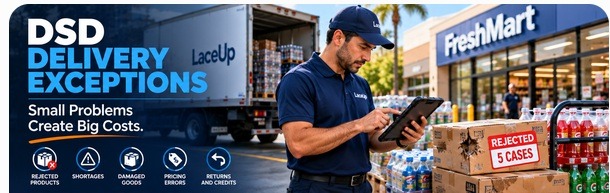
In Direct Store Delivery, a successful route is not simply one that completes every scheduled stop. It is one that delivers the right products, in the right quantities, with accurate invoices and minimal administrative work. But deliveries rarely go exactly as planned. Customers reject products, quantities differ from invoices, merchandise arrives damaged, and last-minute changes require adjustments.
Individually, these incidents may seem insignificant. Collectively, DSD Delivery Exceptions can create substantial hidden costs throughout the distribution operation. In this article, I look at what DSD delivery exceptions really cost a distributor, why most of that cost never appears on a report, and what it takes to catch exceptions at the door, route them to the right fix, and see the patterns behind them.
Why DSD Delivery Exceptions Cost More Than The Product
A delivery exception is any stop that does not go as the order promised: a short shipment, an overage, a refused or damaged item, a wrong price, a late arrival, or a store that cannot receive. The visible cost is the product itself, credited back and sometimes thrown away. The hidden cost is everything that happens afterward. Someone has to process the credit, adjust the inventory, match the paperwork to the driver’s notes, answer the customer’s question about the invoice, and often schedule another visit. According to Wikipedia’s overview of reverse logistics, return costs can reach up to 7% of an enterprise’s gross sales, and the article notes that businesses should monitor customer accounts for hidden costs that arise from return arrangements. Those figures describe returns in general, not DSD specifically, but the direction is clear. Each credit is a small transaction, and small transactions add up fast when a route makes dozens of stops a day.
Why DSD Delivery Exceptions Become Expensive
The real cost of DSD Delivery Exceptions is not necessarily the incident itself. It is the number of processes affected afterward.
- A rejected delivery may require inventory adjustments, credit processing, invoice corrections, and driver settlement reconciliation.
- A shortage can generate customer complaints, additional deliveries, and lost sales.
- An incorrect price may require administrative approval, invoice adjustments, or deductions from payment.
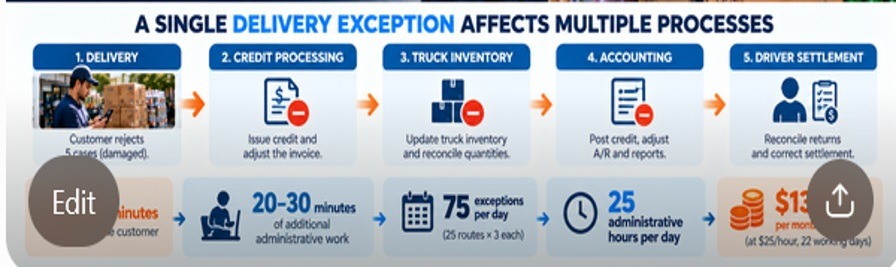
When DSD, inventory, and accounting systems operate independently, employees often reenter the same information several times. Every manual intervention adds labor, delays, and opportunities for errors. The problem becomes particularly significant when exceptions are recorded on paper or communicated through phone calls, emails, and spreadsheets.
From Manual Corrections to Integrated Exception Management
Modern DSD and Route Accounting software can help distributors manage exceptions directly where they occur: at the customer location. Using a mobile device, drivers can record rejected products, returns, shortages, damaged merchandise, and invoice adjustments during delivery. When properly configured and integrated, these transactions can update truck inventory, generate the necessary credit information, and support accurate driver settlement.
Instead of reconstructing what happened after the truck returns, the back office receives structured transaction data captured at the point of delivery. This improves accuracy while reducing repetitive administrative work. More importantly, it makes exceptions measurable.
Turning Delivery Exceptions into Management KPIs
Once distributors capture exceptions consistently, they can begin identifying patterns. Which customers reject the most products? Which routes experience frequent shortages? Which products generate the highest returns? Is pricing corrections concentrated among particular accounts? These questions lead to operational KPIs such as:
- Exception Rate: Percentage of deliveries requiring corrections.
- Returns Rate: Percentage of delivered products subsequently returned or rejected.
- Credit Processing Time: Time required to resolve delivery-related credits.
- First-Time Delivery Accuracy: Percentage of deliveries completed without discrepancies.
Tracking these indicators helps managers move beyond resolving individual problems toward identifying their underlying causes. This is also where Nova, LaceUp’s AI Agent integrated into its DSD environment, adds an interesting dimension. Through AI-powered reporting, Nova can help managers explore operational data and identify patterns that deserve attention. For example, management could investigate whether certain customers consistently generate high return volumes or whether particular routes experience recurring delivery discrepancies, provided the necessary information is available. The objective is not simply to produce more reports;
It is to identify recurring problems before they continue generating unnecessary costs.
Conclusion
Delivery exceptions are not an occasional nuisance. They are a recurring cost that grows quietly with every route, and most of it hides in time, paperwork, and disputes rather than in the product itself. Distributors that control it do three things: they record each exception at the door, connect it to inventory and invoicing automatically, and review patterns often enough to prevent the next one.
At LaceUp Solutions, our DSD Route Accounting Software and Route Management lets drivers handle credits, returns, and invoice adjustments at the door, while our Warehouse Management System keeps inventory in step, all on one shared record. These capabilities, coupled with our AI Nova system, give distributors the tools to make the proper decisions to optimize the cost to serve Subscribe to the LaceUp Blog for weekly insights, or contact us to see how LaceUp can help your operation get ahead of this year’s Q4 before it gets ahead of you.
I hope this article on DSD Delivery Exceptions has been helpful. I will continue to post information related to management, distribution practices and trends, and the economy in general. Our channel has a lot of relevant information. Check out this live demo of our DSD Software.
Sorry, the comment form is closed at this time.