

AI Agents for Distribution: A Practical Guide to Automating the Back Office
Every distribution business is bleeding money somewhere in the back office, although most owners just have not found where yet. It is the accumulation of small, repetitive tasks that quietly consume hours every week: drafting the same category of email over and over, assembling a PDF packet for a dispute or an audit, re-typing information that already exists in three other systems. None of it looks expensive in the moment. All of it adds up to either lost time or a headcount that exists mostly to do work a system should be doing. In this article, I show how AI Agents for Distribution unlock true operational ROI from artificial intelligence. By establishing a structured AI strategy, wholesale distributors can systematically eliminate administrative bottlenecks, improve EBITDA, and scale their businesses without adding unneeded headcount or operational headaches.
What AI Agents For Distribution Actually Are And Aren’t
An AI agent for Distribution is a system that perceives its environment and takes actions to achieve defined goals, potentially adjusting its behavior based on prior experience rather than simply executing a single fixed instruction. That distinction (perceiving, deciding, and acting across multiple steps rather than responding once) is what separates an AI agent from the chatbot or the auto-complete feature most distributors have already tried and shrugged off.
Most of what gets marketed as “AI for distribution” is still task-based: ask a question, get an answer, ask another question. AI agents are different. Give an agent a goal: assemble a deduction dispute packet, draft the week’s overdue-invoice follow-ups, summarize a vendor contract against your standard terms, and it can work through the individual steps needed to get there, checking its own output along the way, without a human walking it through each one. That is the capability that turns AI from a faster typing tool into something that can actually take a recurring workflow off someone’s plate.
Understanding the 4 Tiers of AI Agents for Distribution
Maximizing enterprise productivity requires understanding how AI adoption progresses across four distinct operational tiers:
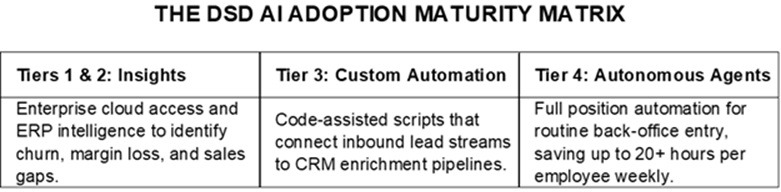
- Tier 1: Enterprise Prompting & Task Assistance: Transitioning from basic public web interfaces to secure cloud organization accounts (such as Claude or GPT) across all staff, enabling instant document analysis, proposal generation, and formula troubleshooting.
- Tier 2: ERP-Connected Conversational Reporting: Hooking AI layers directly into database architectures (via specialized tools like Luna AI) to answer critical queries regarding product churn, dropping margins, and customer retention in natural language.
- Tier 3: Custom Code & Workflow Generation: Utilizing developer platforms like VS Code alongside AI coding models to write custom integration scripts directly on top of your dataset without massive software development overhead.
- Tier 4: End-to-End Autonomous Agent Pipelines: Building autonomous agents that execute full operational roles end-to-end—such as reading incoming email invoices, parsing PDF line items, and logging bills directly in accounting software like QuickBooks.
Real-World Impact: Automating Back-Office Bottlenecks
The true power of Tier 4 automation lies in reclaiming high-cost labor hours. In traditional back-office operations, processing inbound accounts payable bills requires manually transcribing emailed PDFs into accounting software, a task consuming 20 or more hours per week for a single clerk. By deploying an autonomous agent to monitor inbound emails, parse line items, and generate bills in QuickBooks automatically, that labor is completely liberated. Similarly, inbound sales prospect research can be automated end-to-end. Custom agents can extract website leads, perform web and LinkedIn research, calculate target company revenue, identify key decision-makers, and enrich CRM fields automatically. You can explore how these data pipelines connect directly with field sales and dispatch in The Role of AI in DSD Route Optimization. Reallocating administrative talent toward high-value growth initiatives drastically improves operational margins without increasing headcount.
Transforming the Workforce: The Rise of Senior Operators
As autonomous agent pipelines commoditize repetitive clerical tasks, the nature of wholesale distribution roles is fundamentally shifting. Just as early enterprise computing eliminated the need for large teams to manually service servers, AI agents remove routine data entry. This evolution creates a strong demand for skilled operators who understand business strategy and can direct AI tools effectively. While AI can analyze vast datasets and execute repetitive processes, human expertise remains indispensable for high-touch sales calls, strategic account negotiations, and new product creation, activities governed by core principles of business process automation. Empowering senior leaders to direct AI agents establishes a lean, highly resilient operational model.
Conclusion
Leveraging AI in distribution goes far beyond adopting software: it fundamentally reshapes how a wholesale company operates and scales. By progressing from basic prompt assistance to ERP-connected reporting and autonomous workflow agents, distributors can eliminate administrative overhead, protect profit margins, and expand operations without adding unnecessary complexity. In today’s distribution landscape, the future belongs to organizations that pair intelligent AI systems with experienced industry leaders.
At LaceUp Solutions, our Route Accounting, WMS, and B2B platforms are built to be the clean, connected system of record that this kind of automation needs to actually do the work: proof of delivery, invoices, and inventory data that is retrievable in seconds rather than scattered across inboxes and spreadsheets. Subscribe to the LaceUp Blog for weekly insights, or contact us to see how LaceUp can help your operation build the foundation this technology needs to succeed.
I hope this article on AI Agents for Distribution have been helpful. I will continue to post information related to management, distribution practices and trends, and the economy in general. Our channel has a lot of relevant information. Check out this video I just published, that walks through exactly to implement these AI Agents for Distribution.
Sorry, the comment form is closed at this time.