

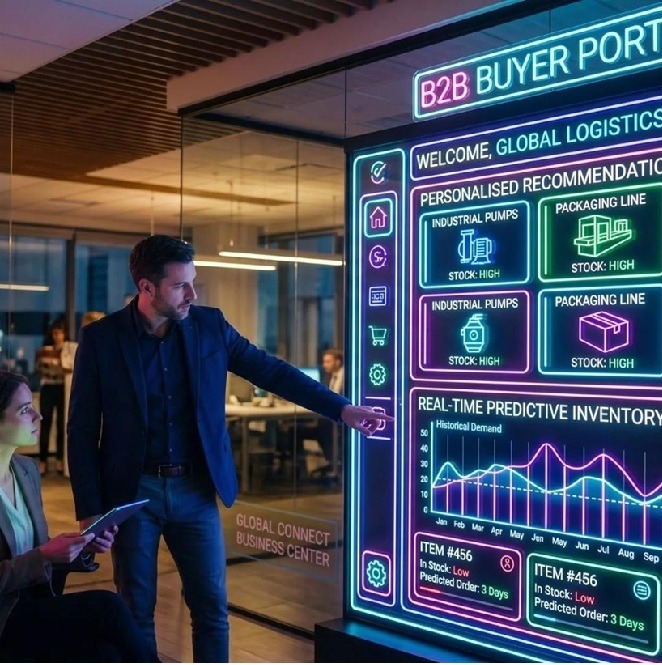
B2B Self-Service Ordering: Why Digital Ordering Has Become a Competitive Advantage for Distributors
The expectations of B2B buyers have undergone a massive shift. Store managers, independent grocers, and food service operators no longer want to wait for a sales representative to visit in person or place phone calls during rigid business hours just to restock fast-selling inventory. Instead, they demand the convenience, speed, and 24/7 accessibility of consumer-grade digital shopping experiences.
For Direct Store Delivery (DSD) distributors, implementing B2B Self-Service Ordering portals is no longer just a nice-to-have feature; it is a critical competitive necessity. Giving retail clients a dedicated mobile app or web portal to place orders, review contract pricing, and track deliveries frees up sales teams to focus on revenue growth rather than administrative order entry. In this article, I cover what is actually driving the shift toward B2B Self-Service Ordering, what it costs distributors who have not made the move, and what a self-service ordering channel needs to do well to succeed alongside, not instead of, the sales relationships that still matter.
The Shift from Order Takers to Revenue Drivers
B2B refers to transactions conducted between businesses, such as a manufacturer supplying goods to a wholesaler or a wholesaler supplying goods to a retailer, as opposed to transactions involving an individual consumer. The internal expectations inside that relationship have shifted dramatically in the last few years, largely because the humans doing the buying have changed generations.
Traditionally, route sales reps spent a significant portion of their store visits performing manual stock checks and writing reorders. B2B self-service portals transform this dynamic completely by addressing key operational friction points:
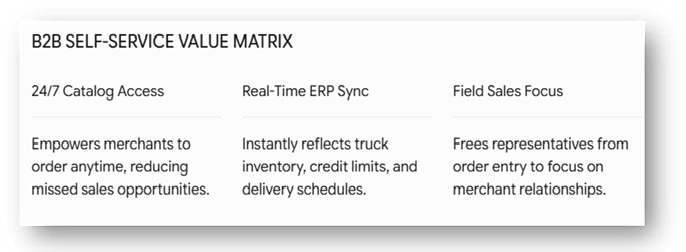
- 24/7 Ordering Flexibility: Retailers can place emergency reorders late at night or during weekend store rushes when standard distribution back offices are closed.
- Account-Specific Contract Pricing: Portals automatically display personalized tier pricing, pre-negotiated volume discounts, and promotional allowances, eliminating manual price quoting errors.
- Higher Order Frequency & Size: Self-service platforms make it effortless for merchants to add new SKUs, leading to higher overall order values and fewer stockouts on retail shelves.
Challenge 1: The Hidden Cost Of Phone-And-Email Order Taking
A manually entered order, taken by phone, keyed from an email, or copied from a fax, costs an estimated $20 to $38 in labor once data entry, confirmation, error correction, and ERP re-keying are accounted for. An order placed through an integrated self-service portal costs roughly $1 to $5 to process. Multiplied across hundreds or thousands of orders a month, that gap is not a rounding error; it is a direct hit to operating margin that never shows up as a single line item.
Distributor sales and customer service teams typically spend 40% to 60% of their time on order management activity: entering orders, checking pricing, confirming availability, and tracking down status updates for accounts that could look all of that up themselves in seconds with the right tool. That is time not spent prospecting new accounts, deepening relationships with the highest-value customers, or solving the problems that actually require a human on the phone.
Challenge 2: What Happens When Distributors Don’t Adapt
The risk of standing still is not hypothetical. With three out of four B2B buyers willing to switch suppliers for a better digital experience, a distributor whose only ordering channel is a phone call is quietly vulnerable every time a buyer has a frustrating experience. Buyers do not always complain about this. They simply start giving more of their volume to whichever supplier makes reordering easiest. This dynamic is easy to underestimate because it rarely costs a distributor an entire account overnight. It costs a percentage of wallet share, order by order, to a competitor whose portal made the reorder decision effortless. By the time that erosion is visible in the numbers, it has usually been happening for months.
Challenge 3: B2B Self-Service Ordering Doesn’t Mean Rep-Less: It Means Rep-Freed
The instinct many distributors have about B2B self service ordering portals is that they threaten the sales relationship. In practice, the opposite tends to happen. Distributors who have shifted routine reorders to a self-service channel report recovering 15 to 25 hours per rep, per week; hours that were previously consumed keying orders that required no actual selling. One documented case saw a distributor move 25% of routine orders to self-service within twelve months and cut rep time on order entry by 35%, freeing that capacity for the parts of the job that a portal cannot do: identifying upsell opportunities, resolving account issues, and building the relationship that keeps a customer loyal even when a competitor’s price looks attractive.
What B2b Self-Service Ordering Requires To Work For Distributors
B2B Self-service ordering only succeeds if it reflects what the buyer would get from a rep; otherwise, it becomes a second, less trusted channel that buyers abandon after one bad experience.
Real-time inventory and pricing, not yesterday’s catalog. A buyer who orders an item shown as available, only to be told later it is out of stock, will not trust the portal a second time. Pricing has to reflect the account’s actual negotiated terms, not a generic list price.
Account-specific catalogs and order history. Every buyer should see their own products, their own pricing, and a one-click reorder of their last purchase — not a generic storefront built for a stranger.
Mobile-first design. Most B2B reordering now happens from a phone in the middle of a workday, not from a desktop during dedicated ordering time. A portal that only works well on desktop is solving yesterday’s problem.
Direct integration with route accounting and the ERP. An order placed through the portal needs to flow straight into the same system that manages routes, inventory, and invoicing — not into a separate silo that someone still has to key in by hand, which defeats the entire purpose.
A visible path back to a human. The best self-service tools make it effortless to escalate to a rep when something falls outside the routine, so the portal handles the 80% of routine orders without becoming a wall between the buyer and the relationship.
Conclusion
B2B Self-Service ordering is no longer a differentiator that a handful of forward-thinking distributors offer as a convenience. It is baseline infrastructure that the majority of buyers now expect, and the distributors without it are competing at a structural disadvantage against every supplier who has already made the shift. The opportunity is not really about technology adoption for its own sake; it is about giving buyers the experience they have already decided they want, while giving sales reps back the hours that manual order entry has been quietly consuming for years.
At LaceUp Solutions, our B2B Self-Service App and B2B Wholesale Ecommerce solutions connect directly into DSD Route Accounting, so every self-service order flows into the same system that manages routes, inventory, and invoicing; no re-keying, no separate silo. Subscribe to the LaceUp Blog for weekly insights, or contact us to see how LaceUp can help your operation close every route with confidence.
I hope this article on Retailer Deductions have been helpful. I will continue to post information related to management, distribution practices and trends, and the economy in general. Our channel has a lot of relevant information. Check out this video on A Practical Guide for AI Agents for Distribution.
Sorry, the comment form is closed at this time.