

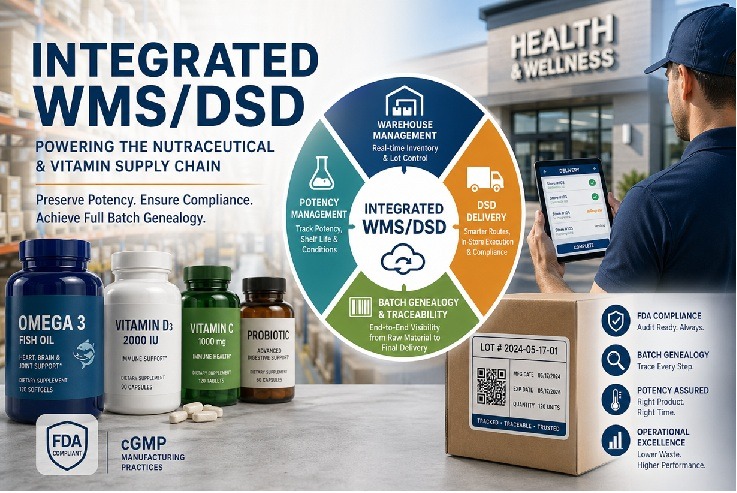
How Integrated WMS/DSD Handles Nutraceutical and Vitamin Supply Chain Challenges
The nutraceutical and vitamin industry demands a level of operational precision that goes well beyond traditional distribution. Products are not only expected to be available on time—they must also maintain their potency, comply with strict regulations, and be fully traceable from origin to final delivery. In this article, I explore how an Integrated WMS/DSD approach enables nutraceutical companies to control product quality, enforce compliance, and maintain complete visibility across the supply chain.
The Core Challenge: Potency, Compliance, and Traceability
Unlike many other products, vitamins and nutraceuticals are inherently unstable over time. Their value is directly tied to the effectiveness of active ingredients, which degrade based on environmental conditions such as temperature, humidity, and exposure to light.
This introduces a critical challenge: inventory cannot be managed solely by expiration dates. A product may still be within its labeled shelf life, but no longer deliver the potency consumers expect. Without precise control, distributors risk shipping suboptimal products, leading to returns, reputational damage, and potential regulatory issues. At the same time, compliance requirements enforced by the U.S. Food and Drug Administration demand rigorous process control.
This combination of potency sensitivity, regulatory pressure, and traceability requirements creates a level of complexity that traditional systems struggle to handle.
How Integrated WMS/DSD Transforms the Operation
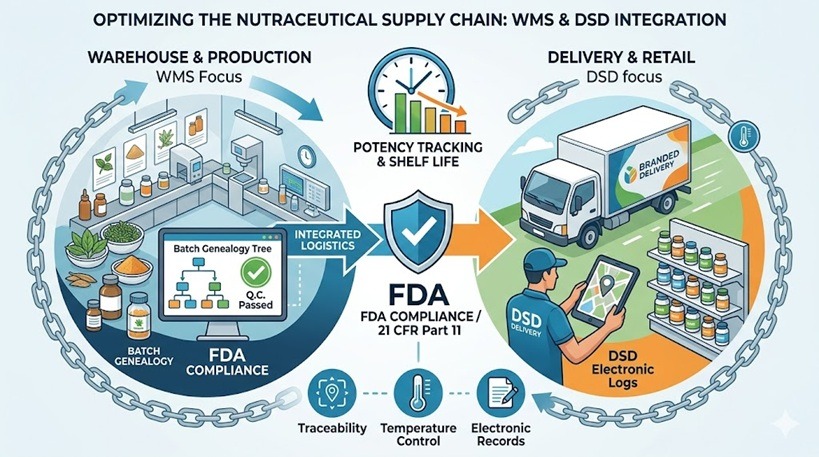
An Integrated WMS/DSD environment eliminates gaps caused by siloed systems by creating a single, unified system that connects warehouse processes with field execution. Inventory, batch data, and transaction records are updated in real time, ensuring that all stakeholders operate with the same information.
Managing Potency with Integrated WMS/DSD: One of the most important capabilities of an Integrated WMS/DSD system is its ability to treat potency as a dynamic variable. Instead of relying solely on static expiration dates, the system can incorporate manufacturing data, storage conditions, and predefined degradation models to estimate the current quality of each batch. This enables a more sophisticated approach to inventory management. Products can be prioritized based on their remaining effectiveness, ensuring that higher-quality inventory is delivered first. This reduces waste, minimizes returns, and protects brand integrity. In the field, this intelligence is extended through mobile DSD applications. Drivers have access to detailed lot-level information and can make delivery decisions that align with potency considerations. Because these decisions are synchronized with the central system in real time, the entire operation remains consistent and controlled.
Strengthening FDA Compliance Through Integration: An Integrated system embeds compliance into daily operations, ensuring that every transaction adheres to regulatory standards. From the moment inventory is received, critical data such as lot numbers, supplier information, and quality status is captured and validated. As products move through the supply chain, every action is recorded, creating a comprehensive audit trail. This level of documentation is essential for inspections, as it demonstrates both compliance and operational control. In addition, the system can proactively identify exceptions, such as non-compliant batches or deviations in handling, and prevent them from progressing further in the process.
Achieving Complete Batch Genealogy: Traceability is one of the most critical aspects of nutraceutical distribution, and it is an area where Integrated WMS/DSD delivers significant value. By linking all stages of the supply chain, the system creates a complete genealogy for every product.
This means that any finished good can be traced back to its raw materials, manufacturing batch, and quality records, as well as forward to its distribution and final delivery. In the event of a recall, this capability allows companies to quickly identify affected products and determine exactly where they were sent.
Aligning Warehouse and Field Execution: One of the most significant operational improvements enabled by Integrated WMS/DSD is the alignment between warehouse and field activities. In a unified system, inventory movements, deliveries, returns, and adjustments are all captured in real time.
This eliminates the discrepancies that often arise when systems are disconnected.
Conclusion
An integrated WMS and DSD system provides the foundation for Potency degradation, strict regulatory requirements, and the need for full traceability of a nutraceutical and vitamin supply chain. The result is a supply chain that is not only compliant and efficient but also capable of delivering consistent product quality.
At LaceUp Solutions, we explore how technology transforms distribution, from warehouse management and route optimization to digital sales enablement. Subscribe to the LaceUp Blog for weekly insights on wholesale growth, innovation, and the future of logistics. For more information, please get in touch with us to learn about our solutions.
I hope this article have been helpful. I will continue to post information related to management, distribution practices and trends, and the economy in general. Our channel has a lot of relevant information. Check out this demo of a Vitamins Production & Raw Materials Warehouse.
Sorry, the comment form is closed at this time.