

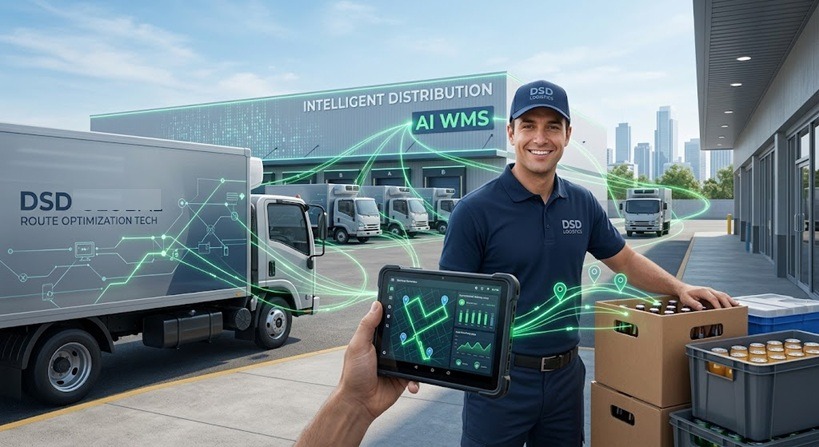
Solving the DSD Driver Shortage: How Modern Route Tech Reduces Headcount Dependency
Ask any DSD distributor what keeps them up at night, and hiring drivers is near the top of the list, right alongside margin and fuel. A route with no driver is not an abstract staffing gap; it is deliveries that do not go out, accounts that start looking at competitors, and a dispatcher scrambling to cover a shift with whoever is available. Most distributors respond to this the same way: raise pay, widen the recruiting funnel, offer a signing bonus. Those moves help at the margins, but they are fighting a labor market that is not going to loosen on its own. The distributors handling this best are not the ones hiring hardest. They are the ones who have reduced the number of drivers their operation actually needs to run. In this article, I cover why the driver shortage hits DSD distribution specifically, what it actually costs when routes run under capacity, and how route technology closes the gap without depending on a hiring market that keeps getting tighter.
The Driver Shortage Isn’t A Cycle: It Is The New Baseline
A labor shortage occurs when the demand for workers in an occupation exceeds the supply of qualified, available, and willing workers to do that job at the prevailing wage. That is precisely the dynamic distributors are living through, and it is not a temporary dislocation. The American Trucking Associations projects a driver shortage of roughly 82,000 in 2026, up from 78,000 in 2024, with the gap projected to exceed 160,000 by 2031 if current demographic and recruitment trends hold. The retention side of the problem is just as severe as the recruiting side. Large carriers report annual driver turnover rates of 90% to 95%, and even smaller regional and local operations see 60% to 75% — meaning a distributor is effectively rebuilding a meaningful share of their driver roster every single year. More strikingly, 35% of new hires quit within their first 90 days, which means the shortage is not solved by filling a seat once. It has to be solved by keeping that seat filled, month after month, in a labor market actively working against that outcome.
The Hidden Headcount Cost Of Inefficient Routes
Here is what most distributors miss when they think about this purely as a recruiting problem: a meaningful share of the driver capacity they are short on is capacity they are already wasting. A route built with poor sequencing, unnecessary backtracking, or no account of real-world traffic patterns burns hours that a better-planned route would not. Every one of those wasted hours is functionally a piece of a driver that the distributor has to hire to make up for.
The same math applies to everything a driver does that is not actually driving or delivering. Manual settlement processes that stretch a route close from 30 minutes to multiple hours, paper-based proof of delivery that requires re-keying at the end of the day, and dispatch decisions made by phone instead of by system all consume driver and support-staff hours that a more efficient operation would not spend. None of this shows up as a line item labeled for what it actually is. It shows up as a distributor concluding they need to hire two more people, when the real problem is that the drivers they already have are spending hours a week on work a system should be doing.
How Route Technology Reduces Dependency On Driver Shortage
This is where the math turns in the distributor’s favor. Route optimization software consistently delivers 15% to 20% more stops per vehicle per shift by improving sequencing and cutting backtracking. On a typical route, adding four more stops per driver per day (a 20% improvement) is the equivalent of adding two full drivers to a ten-driver fleet without hiring a single person. Translated to dollars, that same improvement represents $120,000 to $160,000 in annual labor value recovered from a single technology investment, not a wage increase or a larger recruiting budget.
The most direct path to mitigating driver labor pressure is maximizing the efficiency of your current workforce. When route sequences are dynamically calculated based on live traffic patterns, tight customer delivery windows, and truck cube limits, fleets reclaim significant lost transit time. By re-sequencing delivery territories algorithmically, distributors often service 15% to 25% more retail doors with the exact same driver roster. You can explore how these intelligent dispatch mechanics operate in The Role of AI in DSD Route Optimization. Converting unproductive windshield time into completed delivery stops eliminates the urgent necessity to recruit and hire additional drivers simply to support revenue growth.

What To Look For In Route Technology If You’re Short On Drivers
Not every route accounting system actually reduces headcount dependency. The distributors seeing real results are looking for a specific set of capabilities.
Dynamic route optimization, not static territories: Routes built fresh around real order volume, real traffic conditions, and real stop-time data recover far more capacity than routes that have been drawn the same way for years out of habit.
Real-time re-sequencing for call-outs: When a driver calls in sick, the system should be able to redistribute that route across the remaining team without a dispatcher manually rebuilding it stop by stop under time pressure.
Digital settlement and proof of delivery: Every hour a driver spends on manual paperwork instead of the next stop is an hour of headcount capacity the distributor is paying for and not using.
A simple enough interface to cross-train quickly: In a market with 35% of new hires leaving within 90 days, a system a new driver can learn in a day rather than a week directly improves the odds that early turnover does not repeat itself.
Visibility that reduces burnout, not just routes: Overtime and unpredictable schedules are a leading driver of turnover. Technology that keeps routes realistically sized for the hours available protects retention as much as it protects efficiency.
Conclusion
The driver shortage is not a problem distributors are going to hire their way out of; the labor market will not cooperate. What is within a distributor’s control is how many drivers a given volume of business actually requires. That number is far more flexible than most owners assume once route sequencing, dispatch, and field paperwork no longer rely on manual work. The distributors treating this as much a technology problem as a recruiting problem are the ones running full route counts while their competitors are still posting job ads.
At LaceUp Solutions, our Route Management and DSD Route Accounting Software are built to close exactly this gap by optimized routing, digital settlement, and real-time dispatch that let your existing drivers cover more ground without burning out. Subscribe to the LaceUp Blog for weekly insights, or contact us to see how LaceUp can help your operation run on the drivers you already have.
I hope this article on driver shortage have been helpful. I will continue to post information related to management, distribution practices and trends, and the economy in general. Our channel has a lot of relevant information. Check out this video on Cross Docking Explained.
Sorry, the comment form is closed at this time.