

Integrated WMS And Route Accounting: Close the Inventory Gap Between Warehouse and Route
Ask a distributor why their inventory numbers never quite match reality, and the honest answer is rarely “we don’t track inventory.” It’s that they track it twice: once in the warehouse and once on the route, in two systems that don’t talk to each other. The warehouse team knows what’s on the shelf. The route accounting system knows what left on the truck and what came back. Neither one, on its own, knows what actually exists at any given moment, and the gap between those two pictures is where shrinkage, phantom stock, and bad purchasing decisions all quietly live. In this article, I cover the importance of an Integrated WMS, why running the warehouse and the route as separate systems creates inventory discrepancies almost by design, what that actually costs a distributor over a year, and what real WMS integration looks like when the warehouse and route accounting finally operate as one system instead of two.
WHY THE WAREHOUSE AND THE ROUTE CAN’T RUN ON SEPARATE SYSTEMS
A WMS is software designed to support and optimize warehouse or distribution center management, guiding inventory receiving and put-away, and providing the tools to optimize picking, packing, and shipping. That definition already hints at the problem: a WMS is built to know everything that happens inside the four walls of a warehouse. Route accounting is built to know everything that happens after a truck pulls out. When those two systems are separate products that sync on a schedule — or don’t sync at all, the inventory number each one reports is really just its own half of the story treated as if it were the whole thing.
For a DSD distributor, that gap is not a rare edge case. It’s the daily norm. A truck loads out with inventory pulled from the warehouse, sells some of it, returns some of it, and the warehouse needs to know the exact outcome to know what’s actually on the shelf again — in real time, not at the end of a nightly batch job. Without an integrated WMS tying the warehouse and the route to the same live inventory record, that reconciliation happens by hand, hours or days after the fact, and every hour of lag is an hour where two systems are quietly disagreeing about the truth.
WHAT SHOWS UP WHEN THERE IS NO INTEGRATED WMS
The accuracy numbers tell the story plainly. Warehouses relying on manual tracking and disconnected systems typically run inventory accuracy between 65% and 75%, while operations running a properly integrated WMS routinely exceed 98%. That is not a marginal difference — it is the gap between an inventory count a distributor can actually plan around and one that is closer to a guess dressed up as a number.
The downstream cost of that gap is well documented outside of distribution too. Businesses with poor inventory accuracy incur costs up to three times higher than businesses with high accuracy, driven by the combination of emergency reorders, missed sales from phantom stockouts, write-offs of inventory that turns out not to exist where the system says it does, and the labor spent chasing down every discrepancy.
THE HIDDEN COST OF MANUAL RECONCILIATION BETWEEN WAREHOUSE AND ROUTE
When there is no integrated WMS and the routes run on a separate system, someone has to be the bridge between them, and that job usually falls to a person doing manual data entry at the end of the day. Inventory teams working across disconnected systems spend an average of 16 hours a week ( roughly 104 working days a year) manually syncing data between platforms, at an estimated cost of over $21,000 per entry-level employee annually just for that reconciliation work. For a distributor running multiple routes out of a single warehouse, that is not one person’s part-time task. It is a recurring operational cost that exists purely because the warehouse and the route were never actually one system to begin with.
WHY THIS GETS WORSE AS YOU SCALE
A distributor running one warehouse and three routes can often paper over disconnected systems with enough manual attention. A distributor running multiple warehouses and dozens of routes cannot: the reconciliation burden scales faster than the headcount available to handle it, and small discrepancies that were once minor annoyances start compounding into purchasing decisions based on genuinely bad data. Buying more of a SKU the system shows as low, when it’s actually sitting misallocated on a truck, is a direct, measurable cost of a warehouse and a route accounting system that don’t share one inventory truth.
Data silos are not just a distribution-specific problem: 80% of organizations identify data silos as the single biggest barrier to automation and AI, and a comparable share say those silos limit their ability to make real-time, data-driven decisions. For distributors, the practical version of that statistic is simpler: a warehouse team and a route accounting team working off different numbers cannot make good decisions together, no matter how skilled either team is individually.
WHAT REAL WMS INTEGRATION LOOKS LIKE
Not every system that claims to “integrate” the warehouse and the route actually closes this gap. The distributors who solve this look for a specific set of capabilities, not just a checkbox on a spec sheet, as covered in a recent article on integrating DSD systems.
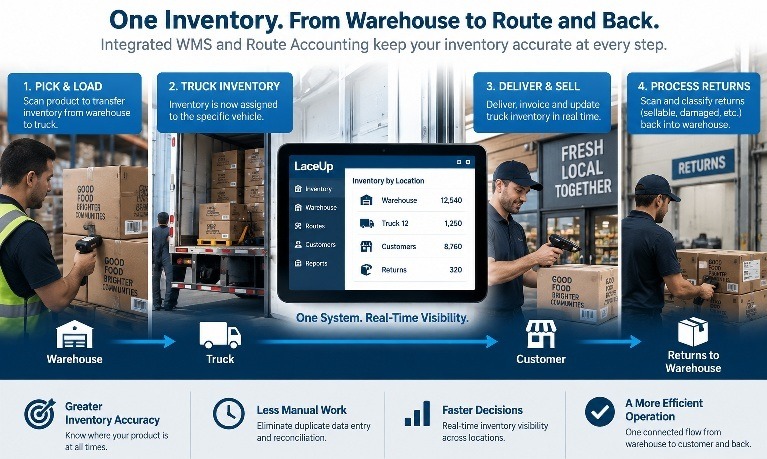
One inventory record, not two systems syncing on a schedule: Real WMS integration means the warehouse and route accounting read and write to the same live inventory data, not two separate databases reconciled by a nightly batch process that leaves a standing gap during business hours.
Truck loading and returns tracked as warehouse transactions: When a truck loads out or comes back, that movement should update the warehouse’s bin-level inventory immediately — not require a separate manual entry to tell the warehouse what the route already knows.
Lot and expiration tracking that follows the product from bin to truck to delivery: For food and beverage distributors specifically, a WMS that loses lot-level visibility the moment product leaves the warehouse defeats the purpose of tracking it in the first place.
Cycle counts that reconcile against route activity, not just static shelf counts: A cycle count that doesn’t account for what’s currently loaded on trucks will always show a discrepancy that isn’t actually a discrepancy, just inventory that’s temporarily in transit.
A single reporting layer for both warehouse and route accounting: If the warehouse manager and the route accounting team are pulling numbers from two different reports to make the same decision, WMS integration hasn’t actually happened yet — it’s just two systems that occasionally compare notes.
CONCLUSION
Inventory discrepancies are rarely a warehouse problem or a route problem on their own. They happen by default when the two operate as separate systems that only occasionally check in with each other. The distributors with real inventory accuracy aren’t the ones with the most diligent reconciliation staff; they are the ones who removed the need for reconciliation by making the warehouse and the route report from the same live number in the first place.
At LaceUp Solutions, our Warehouse Management System and DSD Route Accounting Software are built on a single, shared inventory record, so a truck loading out, a return coming back, and a warehouse cycle count all reflect the same live number instead of three separate stories that someone has to reconcile by hand. Subscribe to the LaceUp Blog for weekly insights, or contact us to see how LaceUp can help your operation get ahead of this year’s Q4 before it gets ahead of you.
I hope this article on integrated WMS and Roote Accounting has been helpful. I will continue to post information related to management, distribution practices and trends, and the economy in general. Our channelhas a lot of relevant information. Check out this video on Live Tour of a Real Warehouse Management.
Sorry, the comment form is closed at this time.