

Beverage Distribution Route Accounting Trends: Navigating the Hybrid Future of Distribution
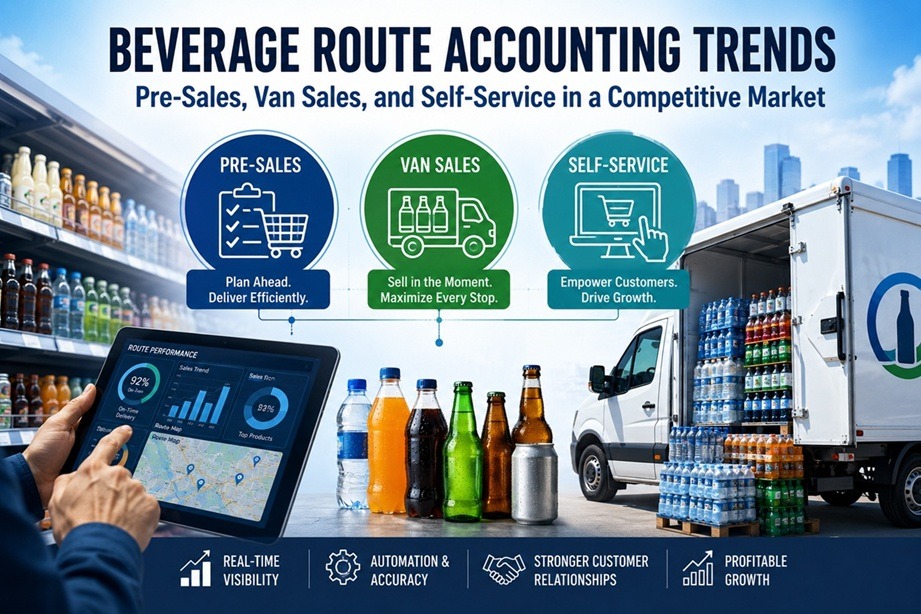
The beverage distribution industry is evolving rapidly. Rising operational costs, changing consumer expectations, tighter retailer requirements, labor shortages, and increasing competition are forcing distributors to rethink how they manage route accounting operations. Beverage companies that once relied on traditional paper-based systems and manual reconciliation processes are now adopting more agile, technology-driven approaches to stay competitive. In this article, I address the three operational models dominating the conversation in modern beverage distribution: Pre-Sales, Van Sales, and Self-Service Ordering. Each model addresses different market demands and operational realities, and many distributors are now combining all three into hybrid strategies supported by integrated DSD and route accounting platforms.
The Growing Complexity of Beverage Distribution
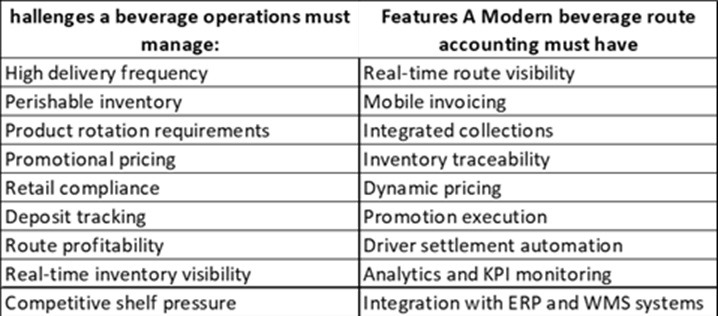
The table summarizes the challenges posed on beverage distribution operation and, conversely, the features a moder beverage Route Accounting System must have.
Beverage Distribution Pre-Sales: The Data-Driven Consultant
In the pre-sales model, sales representatives visit retailers to secure orders, which are then delivered by a separate driver within 24–48 hours. In 2026, this model has shifted from simple order-taking to strategic account management.
- The Trend: Sales reps now function as consultants. Equipped with AI-driven tablets, they use “Depletion Analysis” to show retailers exactly why they should swap a slow-moving legacy beer for a high-growth Spirit-based RTD (Ready-to-Drink).
- RAS Integration: Modern systems provide “Suggested Orders” based on historical data and local trends, reducing out-of-stocks and ensuring the right product mix is on the shelf.
Van Sales (DSD): The King of Agility
Van Sales, or Direct Store Delivery (DSD), involves the driver selling and delivering inventory directly off the truck. This remains the gold standard for high-turnover products and impulse-buy locations like convenience stores.
- The Trend: “Real-Time Inventory Synchronization” is the critical differentiator. Drivers can no longer afford to “guess” what’s in the back of the truck.
- The Competitive Edge: Mobile printers and cloud-connected handhelds allow for instant invoicing and electronic proof of delivery (ePOD). This immediate reconciliation is vital as distributors face “distributor fatigue” from retailers who demand faster, more accurate service.
Self-Service Portals: The New Frontier
Perhaps the most significant shift in 2026 beverage distribution is the rise of the B2B Self-Service Portal. As e-commerce in the F&B sector grows at a CAGR of 16.9%, retailers increasingly want to place orders on their own time—often at 2:00 AM after a late shift.
- The Trend: Distributors are launching “Omnichannel” portals where customers can view their order history, download invoices, and place re-orders without waiting for a sales rep.
- The Synergy: This doesn’t replace the sales rep; it frees them up. While the customer handles the “staples” via the portal, the rep can focus on introducing new premium lines or experiential marketing during their physical visits.
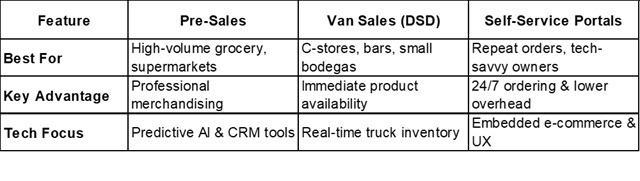
Comparing the Three Pillars
The Competitive Core: Integrated Route Accounting
The “Competitive Market” isn’t just about who has the best soda or craft beer; it’s about who has the best visibility. In 2026, a fragmented system is a failing system. The most successful beverage distributors are using Unified Route Accounting which merges these three models into a single “Source of Truth.”
- Forecasting & Agility: With global volumes for traditional categories like wine and beer declining slightly, distributors are using RAS to pivot quickly toward growth segments like functional beverages and non-alcoholic alternatives.
- Sustainability as a Metric: Route optimization is no longer just about saving fuel—it’s about meeting ESG (Environmental, Social, and Governance) targets that retailers now demand.
- Financial Accuracy: With interest rates remaining a factor, “Days Sales Outstanding” (DSO) is a critical KPI. Automated billing through self-service and van sales ensures cash flow remains liquid.
Conclusion
The winning strategy in 2026 is not choosing between Pre-Sales, Van Sales, or Self-Service; it is mastering the mix. By leveraging a robust Route Accounting System, beverage distributors can offer the high-touch service of a consultant, and the speed of a DSD driver, while keeping their margins intact in an increasingly crowded market.
At LaceUp Solutions, we explore how technology transforms distribution, from warehouse management and route optimization to digital sales enablement. Subscribe to the LaceUp Blog for weekly insights on wholesale growth, innovation, and the future of logistics. For more information, please get in touch with us to learn about our solutions.
I hope this article have been helpful. I will continue to post information related to management, distribution practices and trends, and the economy in general. Our channel has a lot of relevant information. Check out this video on Route Optimization.
Sorry, the comment form is closed at this time.