

How AI Is Solving Your Worst Inventory Accuracy Problems
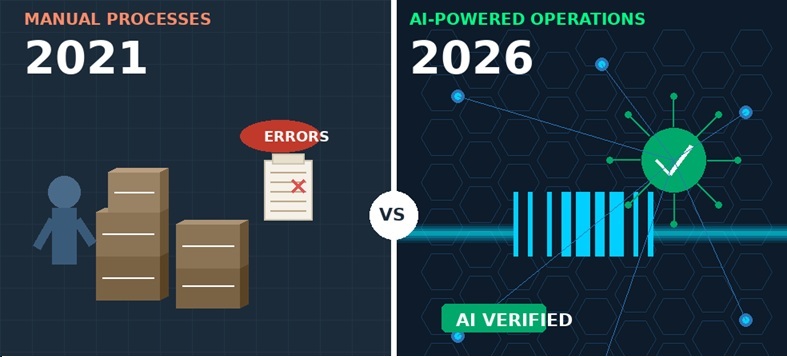
In 2021, LaceUp published a video titled How To Fix Your Worst Inventory Issues that outlined five critical pain points facing distributors: receiving errors, picking mistakes, cycle count gaps, incorrect truck loading, and manual data entry failures. The advice was practical and the problems were real. Five years later, every one of those problems still exists, but Artificial Intelligence is now solving your inventory accuracy problems at a level no manual process ever could.
As we explored in our recent series on DSD AI for Demand Forecasting and AI WMS to Optimize Inventory Velocity, Artificial Intelligence is now embedded directly into the systems distributors use every day. According to Wikipedia’s overview of inventory control, inventory accuracy is fundamental to a healthy supply chain. In this article, I revisit each of the five original problems and show exactly how AI addresses them today.
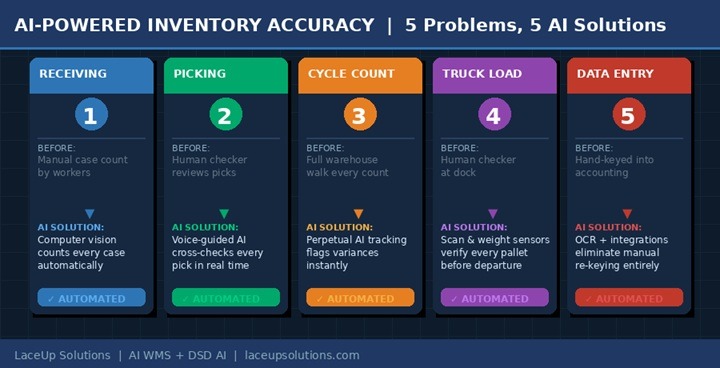
Inventory Accuracy Problem 1: Receiving Errors — Caught Before They Happen
The 2021 video identified the receiving dock as the single biggest source of inventory discrepancies. Vendors short-ship or send the wrong product, and workers miscount during intake. The manual fix required breaking down every pallet case by case and reporting all discrepancies to the back office by hand. AI-powered receiving systems now use computer vision cameras and barcode scanning to verify every case as it comes off the truck, automatically comparing it against the purchase order in real time. Machine learning models trained on vendor shipping history can even predict which suppliers are most likely to deviate from the PO, prompting staff to apply extra scrutiny before the truck door opens.
The result is a receiving process that protects inventory accuracy from the very first moment product enters the warehouse — without adding labor or slowing throughput.
Problem 2: Picking Errors — AI Guides Every Pick
Picking mistakes (too much, too little, or the wrong product) damage customer relationships and distort inventory records. The 2021 recommendation for small companies was to assign a dedicated checker to double-verify everything, leaving the pick zone. Today, AI-driven picking systems have transformed this process. Voice-directed picking guides warehouse staff through each task in real time, cross-referencing every pick against the order before it is confirmed. Computer vision systems detect when the wrong item or quantity is placed in a tote. For distributors with a Warehouse Management System, AI layers on top to dynamically route pickers based on order urgency and real-time warehouse conditions, reducing both errors and travel time, as detailed in our AI WMS article.
Inventory Accuracy Problem 3: Cycle Count Gaps — AI Monitors Inventory Continuously
Without a WMS in 2021, warehouse teams had to walk every aisle during cycle counts to avoid missing forgotten cases in bin locations. Missed items were written off the books, only to expire in place and flow directly to losses. AI eliminates the guesswork. Modern AI-powered WMS platforms maintain a continuously updated view of inventory using real-time data from every warehouse transaction: receiving, picking, loading, and returns. When the system detects a variance between expected and actual positions, it flags it immediately rather than waiting for the next scheduled count. AI also enables smarter cycle counting: instead of counting everything at once, the system prioritizes locations and SKUs that show the highest variance risk. Warehouse teams spend their time where inventory accuracy matters most, rather than walking aisles that have not moved.
Problem 4: Incorrect Truck Loading — AI Verifies Every Load
One misloaded pallet triggers a cascade: incomplete orders, customer rejections, field invoice changes, and potential loss of the account. The 2021 fix relied on a human checker stationed at the dock to confirm every pallet went on the right truck. AI makes this verification faster and more reliable. Load verification systems use barcode scanning and weight sensors to confirm every pallet assigned to a route is loaded onto the correct vehicle before the door closes. If an item lands on the wrong truck, the system alerts the team in real time, before the truck leaves the yard. AI also optimizes load sequencing: knowing which stops come first on a route, the system recommends how to stack the truck so that the first delivery is most accessible. This reduces unloading time, protects product integrity, and prevents damage-related shortages that would otherwise undermine inventory accuracy in the field.
Problem 5: Manual Data Entry — AI Automates the Back Office
The 2021 video described the most tedious problem: every warehouse transaction had to be keyed in manually into the accounting system. The safeguard was a paper trail of signed originals, verified entries, and stapled copies. It worked, but it was slow and still error-prone.
AI has largely eliminated the need for manual data entry in modern distribution. Optical character recognition (OCR) converts paper documents directly into digital records. AI-powered integrations between WMS, ERP, and accounting platforms automatically post warehouse transactions as they happen: receiving, picking, loading, and returns, with no human re-keying required.
As highlighted in our DSD AI article, the full power of AI emerges when systems are integrated end to end. When a receiving transaction is confirmed at the dock, it simultaneously updates purchasing, accounting, and inventory records. When an order is picked and loaded, the invoice is generated, and the customer account is updated in real time. There is no paper shuffling or manual verification checkbox, since the system verifies itself.
Conclusion
The five inventory problems we identified in 2021 have not disappeared. They still exist in warehouses that have not yet adopted modern technology. The difference is that AI now makes it possible to solve all five simultaneously, systematically, and at a scale no manual process can match.
Achieving consistent inventory accuracy is no longer about adding more checkers or more paperwork. It is about embedding intelligence into the systems your team uses every day, so errors are caught automatically, trends are detected before they become problems, and every transaction is recorded correctly from the moment it happens.
At LaceUp Solutions, we are building distribution technology with AI at its core. Our Warehouse Management System and DSD Route Accounting Software are designed to give you the visibility and control that AI makes possible. Subscribe to the LaceUp Blog for weekly insights, or contact us to see how LaceUp can help your operation take the next step.
I hope this article have been helpful. I will continue to post information related to management, distribution practices and trends, and the economy in general. Our channel has a lot of relevant information. Check out this video on the subject.
Sorry, the comment form is closed at this time.