


Retailer Deductions Management: Turning Chargebacks into Better Business Decisions
In Direct Store Delivery (DSD) operations, consumer goods distributors face a quiet but devastating profit leak: retailer deductions and chargebacks. Major grocery chains, big-box retailers, and convenience store conglomerates routinely withhold payments or issue penalties against supplier invoices, citing unsalable goods, late delivery windows, short shipments, or promotional pricing discrepancies.
While some deductions stem from genuine logistical errors, industry estimates suggest that up to 30% of retailer chargebacks are invalid or inflated. Because traditional back-office systems lack immediate, auditable proof from the receiving dock, distributors often write off these disputed balances as an inevitable “cost of doing business”. In this article, I cover where these retailer deductions actually come from, why so few of them ever get challenged, and what has to change in a distributor’s documentation and systems to keep the retailer relationship intact while getting paid what was actually earned.
Anatomy of Retailer Deductions: Where Margins Leak
Chargebacks in DSD networks rarely stem from a single department; they accumulate across the entire order-to-cash lifecycle. The most common drivers include:
Shortages and Quantity Mismatches: A store clerk signs off on a physical receiving ticket, but the retailer’s automated accounts payable system later flags that three cases were missing, resulting in a short payment on the invoice.
Unsalable Goods and Spoiled Product: Damaged items or short-dated stock are discarded at the store level without clear photo documentation or driver authorization, resulting in unverified credit memos.
Compliance and Appointment Penalties: Strict ‘On-Time In-Full’ (OTIF) mandates penalize distributors for arriving outside narrow delivery windows, even when dock delays are caused by the retailer’s own receiving staff.
Promotional Off-Invoice Discrepancies: Trade allowances and promotional discounts are misapplied or stacked incorrectly across store clusters, resulting in double deductions.
Retailer Deductions Management: Building Dockside Defense: Mobile Proof and DEX/EDI
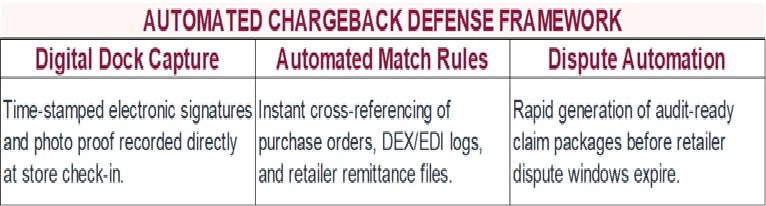
The most effective place to win a chargeback dispute is directly at the retailer’s back door. Relying on paper receipts with faded hand signatures guarantees defeat when contesting short-pays weeks later. Modern DSD route accounting software replaces paper ambiguity with digital proof of delivery (ePOD). Through direct store delivery electronic data exchange (DEX/EDI), handheld devices transmit delivery line items straight into the store’s receiving terminal in real time. Drivers record adjustments, take photos of damaged cases, and capture geo-coded time-stamps before leaving the bay. Coupling dockside data collection with smart dispatch schedules optimizes route performance; you can examine how route efficiency directly reduces OTIF penalties in The Role of AI in DSD Route Optimization. Combining flawless delivery execution with indisputable digital records leaves retailers with zero justification for invalid deductions.
Streamlining Accounts Receivable and Trade Spend Audits
Once a deduction occurs, speed is critical. Most major retail agreements enforce strict 30- to 60-day dispute windows. If a distributor’s financial team takes weeks to manually collect delivery tickets and match them against remittance advice, the contractual window closes, permanently locking in the financial loss. Automating accounts receivable matching within a retailer deduction and chargeback management workflow streamlines the entire recovery process. The system automatically flags short-payments, matches them against digital ePOD files, and compiles audit packages that can be submitted to retailer portals with a single clic, reclaiming lost capital and enforcing contractual trade terms.
Conclusion
Retailer deductions and chargebacks do not have to be an accepted tax on doing business in DSD. By replacing paper-heavy delivery handoffs with digital DEX/ePOD technology and automating back-office dispute workflows, distributors can effectively eliminate unearned penalties. Protecting your margins at the receiving dock ensures that growing sales volume translates directly into net profitability.
At LaceUp Solutions, our DSD Route Accounting Software captures digital proof of delivery, ties every invoice to the records needed to dispute a deduction, and gives owners visibility into recovery the same way they track any other margin driver. Subscribe to the LaceUp Blog for weekly insights, or contact us to see how LaceUp can help your operation close every route with confidence.
I hope this article on Retailer Deductions have been helpful. I will continue to post information related to management, distribution practices and trends, and the economy in general. Our channel has a lot of relevant information. Check out this video on Live Demo of Proof of Delivery Software.
Sorry, the comment form is closed at this time.