

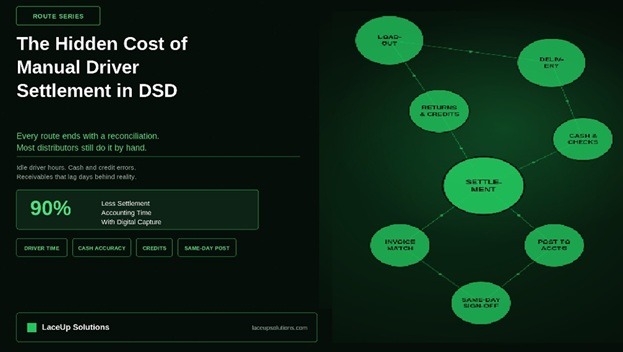
The Hidden Cost of Manual Driver Settlement in DSD
Every DSD route ends the same way: the truck pulls back into the yard, and someone has to prove that what left the warehouse this morning matches what came back tonight, in product, in cash, in credits, and in invoices. Most owners think of it as a routine end-of-day formality. It is not. It is one of the most expensive and most error-prone workflows in the entire DSD operation, and its cost rarely appears as a single line item. In this article, I explain the Hidden Cost of Manual driver settlement in DSD, and how to minimize it.
What Is Driver Settlement?
Driver settlement is the process of reconciling everything that happened on a route: deliveries, returns, credits, cash collected, checks collected, and adjustments, against what the driver loaded that morning, producing a confirmed balance that accounting can post. Drive Reconciliation is the process of comparing two sets of records to ensure the figures are correct and in agreement, and that is precisely what this end-of-route process is meant to accomplish before a single dollar moves onto the books.
In a manual environment, that reconciliation happens on paper. The driver hand-counts returned product, tallies cash and checks, matches paper invoices against a printed load sheet, and hands the stack to a supervisor or bookkeeper who re-keys everything into the accounting system. Every one of those steps is a place where a number can be miscounted, a receipt can go missing, or the final settlement can be wrong. When these activities are managed manually, even a small error can create hours of additional investigation.
HIDDEN COST 1: PAID HOURS THAT PRODUCE NOTHING
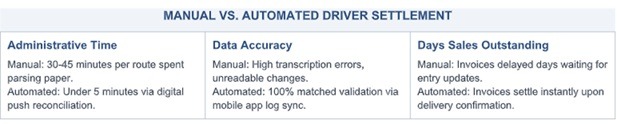
The most visible cost of manual driver settlement is time, and it does not scale the way owners assume. Manual reconciliation work scales linearly, and often worse, with route volume: a settlement that takes 30 minutes with two routes can take three hours or more once a distributor is running ten. Multiply that by five settlement days a week, fifty-two weeks a year, across a fleet of drivers standing idle at the dock waiting for their numbers to be checked and approved, and the number gets large fast.
That idle time is not free. Drivers on the clock waiting to settle are paid the same rate whether they are delivering product or waiting in line at the supervisor’s desk — and in many operations, settlement backups routinely push drivers into overtime territory, adding 1.5x labor cost to a task that adds zero revenue. On the back-office side, staff assigned to manually re-key settlement data spend hours daily performing on work that contributes nothing to growing the business; hours that could go toward collections, margin analysis, or customer service instead.
HIDDEN COST 2: CASH, CREDIT, AND INVENTORY ERRORS
Wherever manual counting and manual data entry intersect, errors follow — and route settlement sits at exactly that intersection. A digit transposed while re-keying a cash total, a credit applied to the wrong invoice, a returned case that never gets logged: each is a small mistake individually, but distributors settling routes manually across dozens of trucks accumulate these errors daily, and few ever go back and find them all.
The financial exposure compounds in three directions. Cash and check shortages that are never fully reconciled become an accepted cost of doing business rather than a red flag. Credits issued in the field but not matched correctly to the original invoice create phantom receivables that make a customer’s account look worse — or better — than it actually is. And unreconciled returned inventory distorts the warehouse’s on-hand counts, which cascades into inaccurate FEFO picking and load-out decisions on the next run. None of these problems announces itself. They surface weeks later as a receivables discrepancy nobody can explain.
HIDDEN COST 3: FINANCIAL VISIBILITY THAT ARRIVES TOO LATE
The third cost is the one that hurts leadership the most, even though it is the hardest to see. Every day that a driver settlement sits unprocessed on a desk is a day accounting cannot post cash, cannot close the receivable, and cannot tell an owner with confidence what the business actually collected. In operations still running paper settlement, it is common for the gap between a route running and its numbers being fully posted to stretch to two or three business days, and during month-end close, that backlog can be significantly worse.
That lag has a real cost. Days sales outstanding creeps upward not because customers are paying slower, but because the distributor’s own back office cannot process what has already been collected. Cash flow forecasts run on stale numbers. And when a supplier or a lender asks for current receivables, the honest answer is “as of two days ago,” which is not the answer a growing distribution business wants to be giving.
Conclusion
Manual Driver Settlement remains one of the most overlooked sources of operational inefficiency in many DSD organizations. Although the process often happens behind the scenes, its impact reaches every part of the business, from accounting and inventory management to customer service and executive decision-making. By replacing paper-based reconciliation with integrated digital settlement, distributors gain faster financial visibility, more accurate inventory records, improved customer satisfaction, and a significant reduction in administrative effort.
At LaceUp Solutions, our DSD Route Accounting Software is built to eliminate manual settlement entirely: every delivery, return, credit, and collection captured digitally in the field and reconciled automatically the moment the route closes. Subscribe to the LaceUp Blog for weekly insights, or contact us to see how LaceUp can help your operation close every route with confidence.
I hope this article on Route Accounting for Health & Wellness have been helpful. I will continue to post information related to management, distribution practices and trends, and the economy in general. Our channel has a lot of relevant information. Check out this video on a live demo of LaceUp DSD Software. See how digital route settlement replaces the manual end-of-day reconciliation process this article describes.
Sorry, the comment form is closed at this time.