

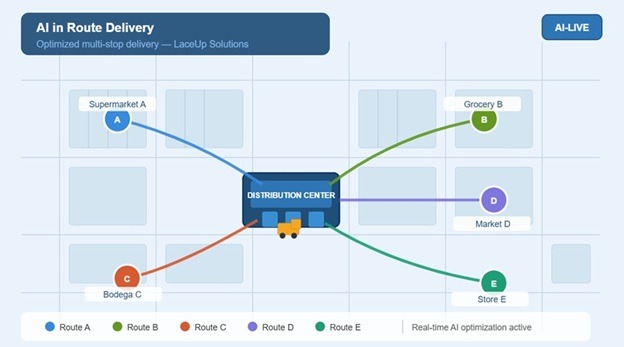
AI in Distribution Part 3 Route Delivery: Last Mile Financial Integrity
This is the third article in our three-part series on how AI is reshaping modern distribution operations. In our first article, we explored the foundations of DSD AI and its impact on demand forecasting. In the second article, we examined how AI helps distributors optimize inventory management and warehouse efficiency. Now, in this final installment, I turn our attention to AI in Route Delivery, which is one of the most visible and immediately impactful areas where artificial intelligence is transforming how distributors move products from their warehouses to store shelves.
WHAT IS AI IN ROUTE DELIVERY?
AI in Route Delivery refers to the use of machine learning, real-time data analytics, and intelligent optimization algorithms to plan, execute, and continuously improve delivery routes. Unlike traditional route planning software, which relied on fixed sequences and historical schedules, AI-powered systems evaluate hundreds of variables simultaneously to determine the most efficient path for every driver, every day. For food and beverage distributors operating in the Direct Store Delivery (DSD) model, this capability is especially valuable. DSD operations involve frequent stops, time-sensitive deliveries, product temperature requirements, and constant variability from traffic, weather, and customer availability. These conditions demand a level of dynamic decision-making that only AI can provide at scale.
KEY BENEFITS OF AI IN ROUTE DELIVERY FOR FOOD DISTRIBUTORS
AI-powered routing is closely related to the Vehicle Routing Problem, a mathematical framework for finding optimal routes for a fleet of vehicles serving multiple stops. What once required heavy computational resources is now embedded in modern DSD software, making advanced route optimization accessible to distributors of all sizes. These are the key benefits:
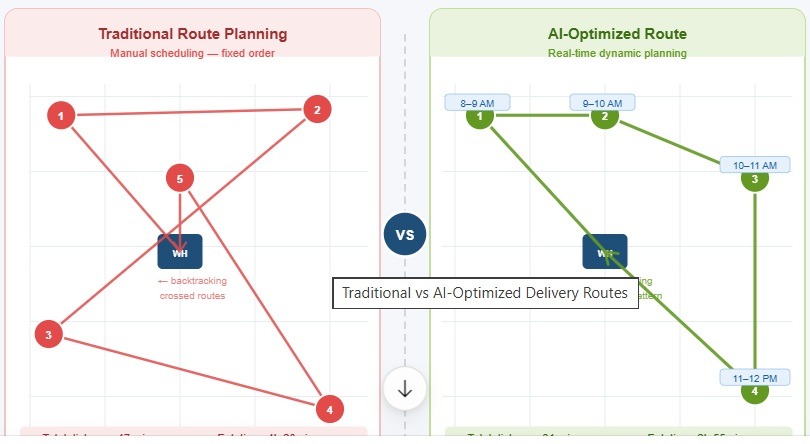
Real-Time Route Optimization: One of the defining advantages of AI in Route Delivery is its ability to respond dynamically to unplanned events. When a driver encounters unexpected road closures, traffic jams, or a canceled delivery stop, the AI system can immediately recalculate the most efficient sequence for the remaining route, without dispatcher intervention. This minimizes delays, reduces fuel consumption, and keeps delivery commitments on schedule.
Reduced Fuel and Transportation Costs: Transportation represents one of the highest controllable costs in food distribution. AI routing engines consistently identify route sequences that reduce total miles driven, improve load utilization, and decrease idle time. Distributors that have implemented AI routing report fuel savings of 10 to 20 percent compared to traditional methods, with corresponding reductions in vehicle wear and maintenance costs.
Improved On-Time Delivery Performance: Retailers have become increasingly strict about delivery windows, especially in categories like fresh produce, dairy, and beverages. AI route planning accounts for customer-specific delivery time constraints and prioritizes stops to ensure the highest-priority accounts are served on time. This reduces the risk of failed deliveries, costly re-delivery attempts, and damaged customer relationships.
Enhanced Driver Productivity: AI systems not only optimize route sequences but also provide drivers with turn-by-turn guidance, stop-level delivery instructions, and real-time notifications about schedule changes. This reduces the time drivers spend on phone calls, waiting for directions, or re-routing manually — allowing them to complete more stops per shift and spend less unproductive time on the road.
Proof of Delivery and Customer Accountability: Modern AI in Route Delivery platforms integrates electronic proof-of-delivery (ePOD) capabilities, allowing drivers to capture signatures, photos, and GPS timestamps at the point of delivery. This creates a clear digital record that protects both the distributor and the retailer in the event of disputes, and provides management with real-time visibility into delivery completion across the entire fleet.
INTEGRATION WITH DSD SYSTEMS
As we discussed in the first article of this series, the true power of AI in distribution lies in its ability to integrate with other technologies. Route delivery AI is no exception. When route optimization is integrated with a DSD system, the benefits multiply significantly. Load planning is automatically adjusted based on forecasted demand, so drivers leave the warehouse with the right products in the right quantities. Route sequences are coordinated with warehouse picking operations to ensure orders are packed in the correct stop order. And customer account data — including order history, special instructions, and delivery preferences — is surfaced directly in the driver’s mobile application.
This level of integration eliminates redundant manual steps, reduces errors, and creates a seamless flow of information from the distribution center to the point of delivery.
CHALLENGES TO CONSIDER
Like any technology investment, implementing AI route delivery requires careful planning. Distributors should be prepared to address several key challenges:
- Data quality: AI routing systems are only as accurate as the data they receive. Customer addresses, delivery windows, vehicle capacities, and road network data must be kept current for the system to generate reliable recommendations.
- Driver adoption: Experienced drivers often have well-established routes and habits. Transitioning to AI-directed routing requires clear communication, proper training, and a phased implementation approach that builds driver confidence in the system.
- System integration: Connecting AI routing with existing DSD, ERP, or warehouse management systems requires technical planning and collaboration between software vendors.
- Cost of implementation: While the ROI on AI routing is typically strong, the upfront investment in software, data infrastructure, and training can be significant.
Conclusion
AI in Route Delivery represents one of the clearest and most immediate opportunities for food and beverage distributors to reduce costs, improve service levels, and gain a competitive advantage. By replacing static, schedule-based routing with intelligent, data-driven optimization, distributors can respond faster to real-world conditions, serve their customers more reliably, and get more out of every driver and vehicle on the road. This concludes our three-part series on how AI is transforming distribution operations, from demand forecasting and inventory management to the final mile of delivery.
At LaceUp Solutions, we are committed to helping distributors navigate this technology transition and realize the full potential of AI-powered DSD systems. Subscribe to the LaceUp Blog for weekly insights on wholesale growth, innovation, and the future of logistics. For more information, please get in touch with us to learn about our solutions.
I hope this article have been helpful. I will continue to post information related to management, distribution practices and trends, and the economy in general. Our channel has a lot of relevant information. Check out this live demo video of a Real WMS.
Sorry, the comment form is closed at this time.