

AI Pricing Optimization: Transforming Pricing and Promotion in Distribution
For decades, pricing decisions in distribution relied heavily on historical sales reports, market experience, customer negotiations, and intuition. While these approaches still provide value, today’s market conditions are becoming too dynamic for manual decision-making alone. This is where Artificial Intelligence is changing the game. As part of our ongoing series exploring AI in distribution, we have already discussed how AI improves Direct Store Delivery operations, Warehouse Management Systems, and Route Delivery management. In this article, I examine how AI Pricing Optimization is helping distributors make smarter pricing decisions, improve promotional effectiveness, and maximize profitability.
THE HIDDEN COST OF PRICING CHAOS IN FOOD DISTRIBUTION
Food distributors operate with razor-thin margins. A full-service distributor handling packaged goods, beverages, or snacks often works within a 3–6% net margin window. In that environment, a pricing error of just 2% on a high-volume SKU can erase the profit from an entire account. Yet in most mid-size distribution operations, price management is still a largely manual process: a sales rep negotiates a deal, someone keys it into the system, and if the entry is wrong, or if the contracted price expires without notice, the distributor quietly absorbs the loss.
According to Wikipedia’s overview of trade promotion management, trade promotions represent the single largest line item in consumer goods marketing budgets, often exceeding 20% of total revenue. For distributors who manage dozens of supplier programs simultaneously, keeping track of which promotions are active, which have expired, and which accounts qualify is nearly impossible without technology. The result is systematic leakage: money that should flow to the bottom line disappears through untracked deductions, missed billing opportunities, and promotions that run longer than authorized.
HOW AI PRICING OPTIMIZATION FOR DISTRIBUTORS WORKS
Traditional price management relies on periodic price book updates, manual exception handling, and reactive corrections after complaints arrive. AI-powered pricing replaces that cycle with a continuous, intelligent layer that monitors every transaction and flags anomalies the moment they occur.
Modern distribution platforms equipped with AI can analyze order history, competitive signals, account size, delivery frequency, and product category to recommend the optimal price for each SKU and account in real time. Rather than applying a single margin target across a product category, the system identifies which accounts tolerate premium pricing, which are price-sensitive, and which are at risk of churn if margins are pushed too aggressively. This is not theoretical. Distributors who have implemented AI-powered pricing report significant reductions in billing disputes, faster execution of price changes, and measurable margin improvements within the first quarter of deployment. The system does not replace the sales rep’s relationship knowledge; it amplifies it by surfacing data the rep could never track manually.
TRADE PROMOTIONS: DISTRIBUTION’S MOST EXPENSIVE GUESSING GAME
Trade promotions are one of the highest-stakes activities in food distribution, and also one of the least disciplined. A supplier launches a promotional program, a temporary price reduction, a scan-down allowance, or a display incentive, and the distributor is expected to pass it through to retailers, track compliance, and deduct the correct amounts from invoices. In theory, this is straightforward. In practice, it is a source of constant financial leakage. The core problem is timing and visibility. Promotions run on specific dates, for specific SKUs, at specific account tiers. Without a centralized system that connects supplier program data to the order management and invoicing workflow, promotional deductions are applied inconsistently. Some retailers over-deduct. A well-documented industry benchmark suggests that promotional leakage (the gap between planned and actual promotional spending) ranges from 15% to 30% for distributors without dedicated trade management tools. On a $10 million promotions budget, that is $1.5 to $3 million in unrecoverable margin disappearing every year.
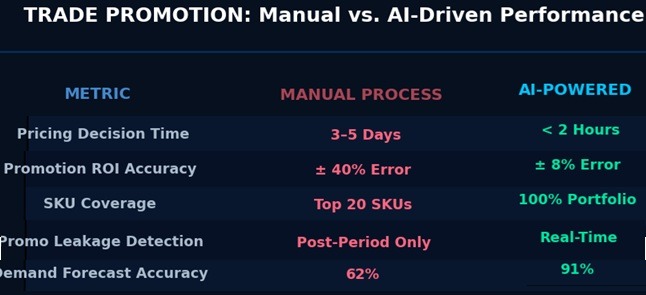
AI PRICING OPTIMIZATION AND PROMOTION ALLOW REAL-TIME ROI TRACKING
The step change that AI brings to trade promotions is not just automation: it is prediction and closed-loop learning. An AI-enabled trade promotion management system does three things that no manual process can replicate at scale.
First, it predicts promotional lift before the promotion runs. By analyzing historical order data, account purchase patterns, seasonality, and comparable promotion performance across similar retailers, the AI model generates a forecast of the volume each promotion will drive for each account. Sales reps can use this data to negotiate better program terms with suppliers and to focus promotional spending on the accounts most likely to respond.
Second, it monitors promotion execution in real time. Rather than waiting for post-period reconciliation, the system flags deduction anomalies as they appear on incoming invoices. If a retailer deducts for a promotion that has already expired, or for SKUs that were not part of the program, the system surfaces the discrepancy immediately, before it becomes a written-off loss.
Third, it learns and improves with every cycle. Each completed promotion feeds results back into the model. Over time, the AI builds a more accurate picture of which accounts, products, and promotion structures generate the best returns, creating a continuous improvement engine that gets smarter with every quarter.
CONCLUSION
The five-part AI in Distribution series has covered the core operational pillars that define modern food distribution: DSD, Warehouse Management, Route Optimization, Inventory Accuracy, and now AI Pricing Optimization & Trade Promotions. In each of these areas, the story is the same. AI is not replacing the expertise and relationships that experienced distribution professionals bring to their work. It removes the friction, the guesswork, and the manual overhead that prevent those professionals from operating at their best. For distributors, AI-powered pricing and trade promotion management represent one of the highest-return investments available today.
At LaceUp Solutions, we are building distribution technology with AI at its core. Our DSD Route Accounting Software and Warehouse Management System are designed to give distributors the visibility, control, and intelligence that modern distribution demands. Subscribe to the LaceUp Blog for weekly insights, or contact us to see how LaceUp can help your operation take the next step.
I hope this article on AI Pricing Optimization have been helpful. I will continue to post information related to management, distribution practices and trends, and the economy in general. Our channel has a lot of relevant information. Check out this video on How To Set Up QuickBooks Price Levels For Mobile Invoicing.
Sorry, the comment form is closed at this time.